Ice Makers
 Chairs
 Kettles
 Projectors
 Air Purifiers
 Headphones
 Smartwatches
 Humidifiers
 Keyboards
 Tablets


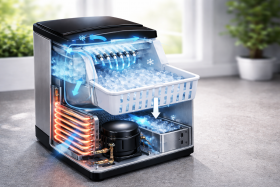
Ice makers use the same principles as refrigerators, freezers, and air conditioning units to freeze water into ice. At the core is the vapor-compression refrigeration cycle, which removes heat from water so it can solidify and cool your drinks. However, depending on the type of ice makers, this process has variations.
My background is in HVAC and refrigeration. I spent years as a Product Manager and Territory Manager working directly with OEMs who build ice makers, walk-in freezers, and similar equipment. I’ve spec’d the sensors and components that go into these machines and seen firsthand why certain units hold up while others end up in a landfill after one summer. That kind of knowledge makes diagnosing problems a whole lot simpler when something goes wrong.
How Ice Makers Work
![[MK]: How Does an Ice Maker Work](https://www.market.com/wp-content/uploads/2026/01/-mk-how-does-an-ice-maker-work-1.png) People tend to overcomplicate this. A portable ice maker runs on the same refrigeration principles as your kitchen fridge or a window AC unit; the application is just different.
People tend to overcomplicate this. A portable ice maker runs on the same refrigeration principles as your kitchen fridge or a window AC unit; the application is just different.
- Step 1: You press the start button, and a pump moves water from the reservoir up to the evaporator assembly.
- Step 2: The evaporator holds a row of metal prongs (some manufacturers call them “fingers”) that sit in the flowing water. Refrigerant circulates through channels machined into the evaporator body, pulling heat out of the metal and dropping the prongs well below 32°F.
- Step 3: Ice builds on the prongs gradually, one thin layer at a time, as water washes over them.
- Step 4: The compressor forces high-pressure refrigerant gas through condenser coils, which sit next to a small fan. Put your hand near the back or side vent while the unit runs, and you’ll notice warm air being pushed out. That heat came from your ice.
- Step 5: After leaving the condenser, the refrigerant passes through an expansion valve, where its pressure drops rapidly. By the time it reaches the evaporator, it’s cold enough to pull heat right out of anything it touches. Water loses heat to the metal prongs, the prongs lose heat to the refrigerant, and the refrigerant carries that heat to the condenser, where it’s dumped into your room.
- Step 6: Once ice reaches the right thickness, the system sends a short burst of warmer refrigerant through the evaporator. That breaks the grip between ice and metal.
- Step 7: The ice drops into the bin below. Any water that didn’t freeze runs back down to the reservoir, and the cycle starts all over again.
Most machines complete this loop in six to fifteen minutes, depending on ice size and room temperature. The first batch usually takes a little longer while the system stabilizes. The speed advantage over freezer trays comes down to direct metal-to-water contact. Cold air transfers heat slowly; refrigerated metal prongs work much faster.
The Main Components of a Portable Ice Maker
![[MK]: How Does an Ice Maker Work](https://www.market.com/wp-content/uploads/2026/01/-mk-how-does-an-ice-maker-work-2.png)
Open up any portable ice maker, and you’ll find the same basic parts inside. What separates a $90 machine from a $300 machine usually isn’t the part list – it’s the quality of those parts.
After years of specifying components for refrigeration OEMs, I can tell you the compressor and water pump are where manufacturers cut corners first. Those two components determine whether your machine lasts five years or five months.
Compressor
Think of the compressor as the engine. Without the compressor, nothing happens. Its job is to push refrigerant around the sealed loop and create the pressure difference that allows cooling to happen. Most portables use small reciprocating compressors. Same technology inside a dorm fridge or a cheap beer cooler. If the compressor fails, you’re buying a new machine. Labor alone costs more than half the price of a replacement unit.
Condenser and Evaporator
The condenser and evaporator are at opposite ends of the heat transfer process. The condenser is mounted near a fan and rejects heat into the room. You can feel it warming the air behind the machine. Block that airflow and performance drops across the entire system.
The evaporator is the cold side. Refrigerant absorbs heat here, chilling the metal prongs where ice forms. Prong shape varies by manufacturer, and that geometry determines whether you get bullets, crescents, or another style.
Water Reservoir and Pump
There’s no water line hookup on a portable unit. You fill a reservoir by hand, usually somewhere between 1.5 and 3 quarts. A float mechanism or electronic probe monitors how much water remains and kills the cycle when the tank runs dry.
The pump itself sits submerged in the reservoir on most models and forces water up to the evaporator prongs. I’ve seen more dead pumps come back on warranty than almost any other part in cheaper machines. If your ice maker stops producing ice but the compressor still runs, the pump is the first thing to check.
Ice Bin and Sensor
Finished ice falls into a bin positioned directly under the evaporator. Most machines use either an infrared beam or a mechanical arm to detect when the bin fills up. Once triggered, the machine pauses production until you empty it.
Portable units don’t refrigerate the bin. Ice melts over time, and that water cycles back through the reservoir for another freeze.
Types of Ice Made by Portable Ice Makers
Not all ice is created equal, and I have opinions.
Bullet Ice
![[MK]: How Does an Ice Maker Work](https://www.market.com/wp-content/uploads/2026/01/-mk-how-does-an-ice-maker-work-3.png)
Bullet ice is the standard output from most countertop machines. It comes out as small cylinders, hollow through the middle. That hollow center happens because of how the freezing process works, not because anyone designed it that way. The outer surface of the prong freezes water first, and the machine releases the ice before the core has time to solidify.
High surface area means bullet ice cools drinks fast. It also means bullet ice melts fast and dilutes whatever you’re drinking. Want to fill a cooler for a tailgate? Bullet ice gets the job done. Trying to enjoy a bourbon or a cocktail without it turning into flavored water? Bullet ice isn’t your friend.
Nugget Ice (Pellet Ice)
Nugget machines don’t use the same prong system as bullet makers. They’ve got an auger that scrapes ice shavings off a frozen cylinder and compresses those shavings into nuggets. It has more moving parts and a higher price tag, but a lot of people think the ice is worth it. Nuggets absorb whatever you’re drinking and have that chewable texture you don’t get from solid cubes.
Crescent or Gourmet Ice
Some higher-end portable machines make crescent-shaped or cube-style ice. Denser, clearer, slower to melt. The evaporator geometry and freeze timing differ from bullet machines, giving air bubbles time to escape before ice hardens.
These machines cost more, but they’re a good choice if presentation matters or you’re tired of watching your drink turn watery halfway through.
How Refrigerator Ice Makers Work (Quick Comparison)
Fridge ice makers use the same cooling principles, but the execution is completely different.
A refrigerator unit ties into your household plumbing. When ice runs low, a solenoid valve opens and meters water into a mold tray. The freezer, already running to preserve your frozen burritos and ice cream, gradually solidifies that water. This usually takes an hour or two. Once frozen, a small heating element warms the mold base just enough to release the cubes, and a motorized arm sweeps them into the storage bin.
The tradeoffs are straightforward. Refrigerator ice makers are slow, but they keep ice frozen indefinitely. Portable units are fast, but they can’t maintain freezing temperatures in the bin, so ice melts and recirculates. Fridge units require plumbing. Portables require manual refilling.
If you want ice without thinking about it, a refrigerator ice maker handles that. Portable units earn their place when you need ice away from plumbing, when your fridge can’t keep up with a party, or when you want a specific type of ice (like nugget) that your fridge doesn’t make.
Why Maintenance Matters
Minerals are the enemy here. Your tap water contains dissolved calcium, magnesium, lime, and other minerals, depending on where you live. When water freezes, those solids get left behind. They coat the evaporator prongs, clog pump impellers, and film up reservoir walls. Every batch adds a little more.
Scale buildup on the evaporator acts like a blanket wrapped around those prongs. Heat can’t transfer properly. The compressor runs longer cycles, energy consumption goes up, and ice production drops. Ignore it long enough, and ice bonds to the prongs instead of releasing.
You have to clean these machines regularly. Every two to four weeks, depending on your water hardness. Diluted vinegar or a commercial cleaner circulates through the system for about 20 minutes, then you flush with fresh water.
Beyond scale, there’s the taste issue. Stagnant reservoir water picks up flavors. Mold finds damp corners. Old mineral residue accumulates. Any of that ends up in your ice. Off flavors or that musty staleness mean something’s growing in there, or buildup has gotten out of hand. Don’t ignore it.
Benefits of a Portable Ice Maker
Let me be honest with you: portable ice makers are great at solving a few specific problems. If you don’t have those problems, save your money.
- Speed: Ten minutes from empty glass to ice in hand. When you’re in the middle of hosting, and the freezer tray is empty, that matters.
- Portability: No plumbing required. RVs, fishing boats, workshop garages, rental cabins, tailgate setups; basically anywhere you’d otherwise make a gas station run for bagged ice.
- Volume: Twenty-five to thirty-five pounds of ice per day from a decent unit. Your fridge ice maker probably does a third of that. Party math favors the portable.
- Ice Type Options: If nugget ice is what you’re after and your fridge makes standard cubes, a portable nugget maker is basically your only option unless you want to keep buying bags.
Tradeoffs exist. You refill the reservoir. You empty the bin. You clean the machine. It takes counter space and runs up your electric bill. Expect some babysitting.
Tips for Getting the Best Results from a Portable Ice Maker
Here’s how to keep your portable ice maker in good shape:
- Give it enough airflow. Place it on a flat surface with six inches of clearance minimum around the unit. The condenser needs to dump heat.
- Fill the reservoir with cool water. Warm or hot water from the tap takes longer to freeze, simple as that.
- Use filtered water. It improves the taste if your municipal supply has a strong chlorine bite or other off-flavors.
- Don’t overfill. Overfilling causes problems. Water can leak out or interfere with the pump. Fill to the line and stop.
- Drain when not in use. Toss any leftover ice sitting in the bin, and prop the lid open so moisture can escape.
- Use in ambient temperatures. The best performance happens between 50°F and 90°F ambient. Colder environments can mess with compressor cycling. Hotter environments slow production because the condenser struggles to reject heat.
Key Takeaways
Portable ice makers use basic refrigeration in a countertop box. They use cold prongs to freeze water with a timed release through continuous cycling.
Most owners never crack the manual or think about what’s happening inside. You’re already ahead if you understand the refrigeration cycle and know which parts tend to wear out first.
Stay on top of maintenance. Give the machine airflow. Use decent water. Do that, and you’ll get years of reliable ice.