
 Kettles
 Projectors
 Air Purifiers
 Headphones
 Smartwatches
 Humidifiers
 Keyboards
 Tablets
 Microphones
 Speakers









Audiophile headphones are designed for faithful, high quality sound rather than convenience. Most are wired, over ear designs that showcase the fine details in your music. If you care more about accuracy, nuance, and build quality than about portability or features, this category is aimed at you.
Unique Features of Audiophile Headphones
Audiophile headphones prioritise faithful sound reproduction above all else.
Many use an open back design, where vented ear cups allow air and sound to move freely, creating a spacious, speaker like presentation with easy instrument placement. The tradeoff is sound leakage and minimal isolation, so they are best in quiet settings. Closed back audiophile models exist for those who need isolation, though they typically produce a more intimate soundstage.
Driver technology also sets this category apart. Audiophile headphones typically employ more advanced driver tech, such as planar magnetic drivers or electrostatic drivers.
Build quality is another hallmark. Metal frames, robust yokes, and premium memory foam pads are common, with larger housings chosen for acoustic performance even if they increase weight. Wide, padded headbands and deep earpads ensure comfort during long sessions, and many parts such as pads and cables are replaceable.
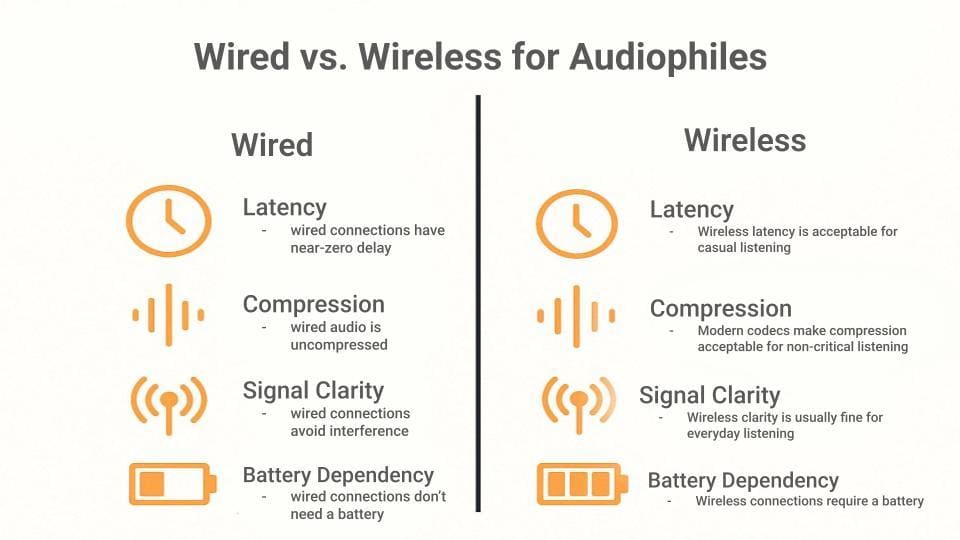
True audiophile models rarely include Bluetooth, ANC, or microphones. They typically rely on wired connections for the cleanest signal and often benefit from a dedicated amplifier due to higher impedance or modest sensitivity. The guiding principle is simplicity: remove non essentials and focus entirely on sound.
Key Specs & Features Explained
Driver Type
This describes how electrical signals become sound.
- Dynamic drivers are the most common, using a lightweight diaphragm and coil in a magnetic field. They are efficient, easy to power from portable devices, and produce a familiar, punchy presentation.
- Planar magnetic drivers use a flat diaphragm with conductive traces suspended between magnets. Because the entire surface moves uniformly, they offer low distortion, deep bass extension, and refined detail, though they are often heavier.
- Electrostatic drivers move an ultra thin diaphragm via static charges, creating exceptionally open, precise sound, but they need a dedicated energizer and sit at luxury prices.
No single driver type is inherently superior. Excellent tuning and thoughtful engineering matter as much as the underlying technology.
Driver Size
This is usually listed in millimeters. Larger diaphragms can move more air, which can support stronger bass and higher output before strain. Many audiophile models use drivers around 50 mm or larger for full range performance. Still, a smaller, well tuned driver can outperform a larger but less refined one.
Frequency Response
Frequency response shows the range of sound a headphone can reproduce, such as 20 Hz to 20 kHz. Some models extend beyond this range, which can imply added headroom or capability at the extremes, even if those frequencies cannot be heard directly. What matters most is smoothness across the entire spectrum, since peaks or dips can alter how natural the headphone sounds.
Harman Curve
This is a researched target that many listeners perceive as balanced. It has a modest bass lift, clear mids, and restrained treble. A headphone does not need to follow it exactly to sound great, yet it provides a helpful baseline, especially for newcomers who want a natural, all round tuning.
Sound Signature
Sound Signature describes the tonal balance.
- Neutral tuning keeps all regions even, making it ideal for accuracy.
- Warm tuning adds bass and softens treble for a smoother, more relaxed presentation.
- Bright tuning highlights treble detail, which can increase clarity but may cause fatigue for some.
- V shaped tuning boosts bass and treble while recessing mids, creating an exciting but less accurate sound.
Audiophile headphones often aim for neutral or mildly warm character. Terms like “analytical” usually suggest a neutral bright signature, while “musical” often points to warmth and ease.
Impedance and Sensitivity
These determine how demanding a headphone is.
- Impedance (in ohms) reflects electrical resistance. Higher values usually mean the headphone needs more voltage and benefits from an amplifier.
- Sensitivity measures loudness per unit of power. Lower sensitivity combined with higher impedance may require dedicated amplification.
Matching the headphone with your source is essential for proper performance.
Total Harmonic Distortion (THD)
THD reflects how much unwanted harmonic content the headphone adds. Most good audiophile models keep THD extremely low, making distortion effectively inaudible at normal listening levels. It becomes relevant only if a headphone measures unusually high or reviews mention audible artifacts.
Comfort and Build
These influence long term enjoyment. Deep pads, secure but not painful clamping force, and smart weight distribution help prevent fatigue. Sturdy construction with replaceable pads and detachable cables ensures longevity, since these components wear over time. Many enthusiasts keep well built headphones for years simply by refreshing pads or swapping cables.
Recommended Models
Flagship Audiophile Headphones ($$$)
Audeze LCD-X (2021 edition)
This planar magnetic open back headphone is known for its clear, controlled presentation and deep, authoritative bass. The tuning leans close to neutral with a gentle warmth, so it is both revealing and enjoyable for long sessions. Large planar drivers deliver fast, low distortion sound that works well for critical listening and studio use. The build uses metal and high grade materials, with thick memory foam pads and a suspension style headband to support the substantial weight. It is relatively efficient for a planar design, yet still benefits from a solid desktop amplifier.
Sennheiser HD 800S
The HD 800S is an open back dynamic headphone often praised for its expansive soundstage and precise imaging. Its ring radiator driver and angled ear cups help create a presentation that feels more like listening to speakers in a room than to typical headphones. The sound is highly resolving and largely neutral, with controlled bass, realistic mids, and refined treble. A lightweight chassis, large cushioned pads, and careful use of plastics and metals make it comfortable despite its size. With 300 ohm impedance, it pairs best with a capable amplifier, where it can show its full potential.
Mid-Tier Audiophile Headphones ($$)
HiFiMan Sundara (Open-Back Planar)
The Sundara offers planar magnetic performance at a mid range price. Its signature is close to neutral with a touch of brightness, featuring tight bass that may feel lean to bass lovers, clear mids, and airy treble. It excels at separation and detail, especially in acoustic and instrumental music. Newer revisions have improved build quality, with a metal headband, comfortable suspension strap, and soft earpads. The impedance is modest, but sensitivity is not very high, so a dedicated DAC or amp helps it perform at its best.
Value Audiophile Headphones ($)
Sennheiser HD 560S
This open back dynamic headphone is well regarded for delivering a reference style tuning at an approachable price. It aims at neutrality with surprisingly deep yet controlled bass, clear mids, and lively but not overly sharp treble. The soundstage is open enough to feel spacious for its class, and imaging is solid. It is easy to drive from common sources and does not absolutely require an expensive amplifier, although better gear can still offer refinements. A light plastic frame, large earpads, and comfortable clamp make it suitable for long listening sessions.