Ice Makers
 Chairs
 Kettles
 Projectors
 Air Purifiers
 Dash Cams
 Headphones
 Smartwatches
 Blenders
 Humidifiers


Allergy Proofing Your Home: Can an Air Purifier Really Help?
Using an air purifier in your home can help reduce allergy symptoms, improve the quality of your sleep, and even lessen your risk of developing chronic illnesses like heart disease.
Airborne allergens, such as dust mites, mold spores, pet dander, and pollen, can trigger a wide range of allergic reactions, including sneezing, coughing, itchy eyes, and asthma attacks. Other indoor pollutants, like smoke from tobacco products or cooking, can also set off or exacerbate allergies, affect sleep, and diminish your overall well-being.
According to the US Environmental Protection Agency, indoor air can be two to five times more polluted than outdoor air—and over 100 times worse in some instances. Fortunately, using an air purifier is a great way to reduce indoor pollutants in your home.
In this article, we’ll explore the impact of indoor air quality on individuals with allergies, along with how air purifiers work, their limitations, and how to select the best unit to allergy-proof your home.
Understanding Allergies and Indoor Air Quality
With the amount of time we spend inside, indoor air quality is something we should all pay attention to. To combat common allergy triggers, you need to understand what’s causing your symptoms, how these pollutants spread throughout your house, and why allergies can become unbearable when indoor air quality plummets.
What Are the Most Common Indoor Allergens?
An allergen is a substance, usually a protein, that triggers a reaction in your body. Your immune system mistakenly identifies the allergen as something harmful, producing antibodies and chemicals that trigger reactions that help your body eject it.
We don’t understand the exact cause of this reaction, but we do know that genetics plays a significant role. More than 50 genes, involved with everything from cell migration to immunoregulation, are known to be associated with the onset of allergic rhinitis or hay fever.
Pollen is one of the most common airborne allergens. These spores, which are released from reproducing trees, weeds, and plants, make their way into your home through open windows or doors, or by sticking to items that you bring inside.
Up to 25% of children and even more adults have a pet allergen. Their allergies are triggered by pet dander (dead skin cells) as well as the saliva or urine of animals with fur or feathers. Unfortunately, these allergens are everywhere, and petless households often have the same levels of dander as those with pets.
Dust mites and cockroaches are two more allergy irritants that are common in our homes. Dust mites are everywhere and generally live on bedding, carpets, sofas, and any soft furnishings, while around 40% of low-income housing likely contain cockroaches.
These pests’ saliva, urine, feces, eggs, other sheddings, and dead bodies can cause allergic reactions. They tend to thrive best when the environment they’re in is hot and humid.
Humid conditions combined with poor ventilation can also lead to mold or mildew growth, causing musty, damp smells and triggering reactions that worsen the symptoms of conditions like asthma.
This becomes especially problematic when the mold begins to release microbial volatile organic compounds (MVOCs) as a byproduct of its metabolic process. These carbon compounds turn into gases at room temperature and can cause headaches, nausea, and irritation of the eyes, nose, and skin.
How Do Allergens Affect Allergy Sufferers?
Sneezing, coughing, congestion, wheezing, headaches, and irritation of the skin, eyes, and face are common symptoms of a wide variety of allergies:
- Allergic rhinitis: Commonly known as hay fever, this allergic reaction is triggered when a sufferer’s nasal passages are irritated, especially from pollen exposure. It reportedly affects 25% of children and 40% of adults globally.
- Asthma: Allergens make breathing harder for people with any type of asthma as they irritate the airways. People with allergic asthma, which is triggered by airborne allergens, are particularly susceptible to these attacks.
- Eczema: Exposure to dust, pollen, and other allergens can trigger eczema flares, leading to dry, itchy, and often irritated skin. Up to 80% of children who have eczema develop asthma or allergic rhinitis later in life.
- Allergic conjunctivitis: Up to 40% of the population will be affected by allergic conjunctivitis at some stage of their lives. Symptoms include red, itchy eyes, white mucus discharge, and swelling on the affected eye.
Allergens can also cause allergic diseases and other long-term health issues, such as hypersensitivity pneumonitis, heart disease, and even lung cancer.
Other Factors Affecting Allergies
It’s not just allergens you should be worried about; it’s also the overall quality of the air you’re breathing that matters.
Indoor air quality (IAQ) refers to the air quality inside and around a building in regard to the occupant’s health and comfort. Outdoor air quality, measured by the Air Quality Index (AQI), strongly impacts a home’s IAQ, but indoor factors (e.g,. temperature, humidity, ventilation, and pollutant levels) have the greatest effect.
Besides allergens, other common contributors to poor IAQ include:
How Do Allergens Circulate in the Home?
Allergens can enter your home through open windows and doors, and ventilation systems that draw in outdoor air. Some of them come from the things inside your home.
For example, your furry friends are a major source of indoor allergens. Pets’ fur and feathers carry these substances, which can be released and begin to circulate in the air as they move around the house and interact with you.
Daily household chores such as dusting, vacuuming, and cleaning are another cause. Vacuum cleaners in particular throw particulate matter (e.g., dust, mold, and other allergens) into the air, either from the motor or settled dust resuspension, where they can trigger allergies.
Even moving about inside your home can disturb allergens and cause them to be airborne. For example, the disturbances caused by walking can resuspend 10–100 million particles per minute.
Then there are your heating, ventilation, and air conditioning (HVAC) systems. Although your HVAC unit has filters to trap debris, they may not filter smaller pollutants and can spread these irritants as the unit circulates air through your home.
This can be especially problematic if your HVAC system isn’t properly maintained. Dust can build up in the air ducts, and mold can grow if the environment is damp, leading to even more allergens being pushed into the air.
Size Matters: How Allergens and Air Pollutants Affect Your Body
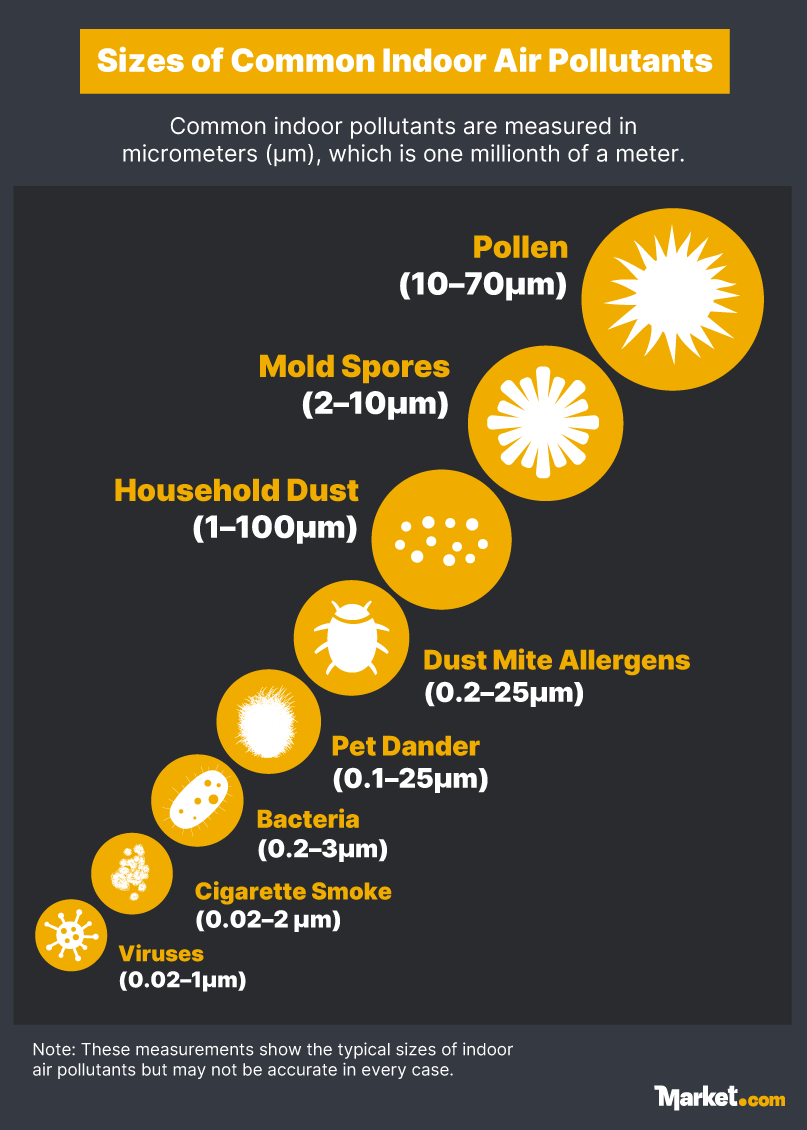
Particulate matter (PM) that’s less than 2.5 micrometers in diameter (around 30 times smaller than the diameter of a human hair) usually comes from combustion emissions and can cause severe damage when it enters your lungs and bloodstream.
Worryingly, PM of up to 10 micrometers in diameter is common in homes around the world. According to the California Air Resources Board, this includes all PM2.5 as well as dust from construction sites, landfills and agriculture, wildfires and brush or waste burning, industry, wind-blown dust from open lands, pollen, and fragments of bacteria.
A study found that for each increase of 10 micrograms per cubic meter of air (mcg/m3) in concentrations of PM10, people with rhinitis were 53% more likely to experience moderate symptoms and 72% more likely for severe symptoms. Similar results were seen for PM2.5 tests.
Indoor air pollution has also been shown to raise the risk of sleep apnea and may contribute to systemic inflammation.
How Air Purifiers Work
Poor ventilation causes pollutants to build up indoors, and opening windows may not necessarily improve the situation. In fact, it can even bring more allergens in. One of the most effective ways to boost air quality is to use an air purifier.
These devices are designed to improve air quality by reducing the concentration of harmful particles in the air.
Most units work by drawing air in using a fan and then pushing it through one or more filters to remove contaminants before releasing the purified air back into the surrounding space. This process runs continuously to increase air quality and maintain a healthy environment.
In this section, we’ll outline the various types of portable air purifiers available on the market today, how they help people with allergies, and what benefits you can realistically expect from using them.
Air Purifiers with HEPA Filters
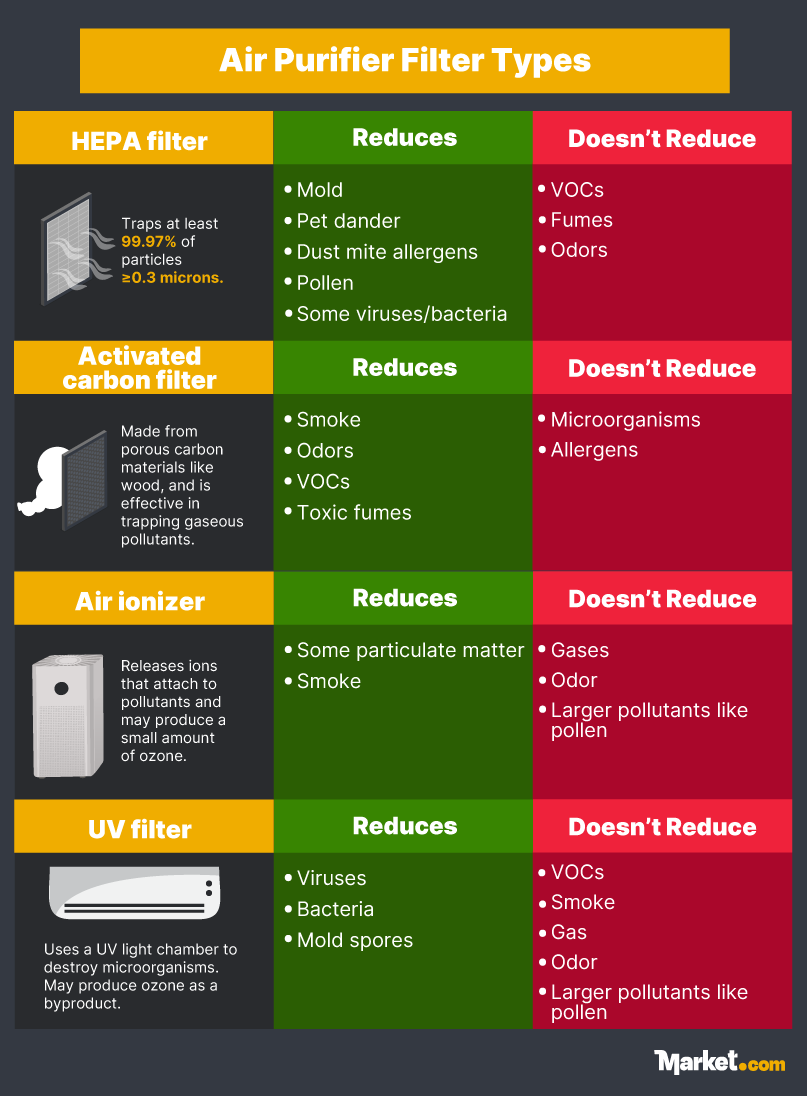
A HEPA (high efficiency particulate air) filter can trap at least 99.97% of PM that’s as small as 0.3 microns. The filter is made up of dense layers of fibers and works mechanically by trapping pollutants as the air passes through.
This enables HEPA air purifiers to capture the most common airborne allergens, including mold, animal dander, dust mite allergen, and pollen. They can also remove some viruses and bacterial droplets. However, they don’t trap VOCs, fumes, and odors.
You’ll find HEPA filters in some newer vacuum cleaners and HVAC units, but the filters often need to be added to these products after you’ve purchased them.
Air Purifiers with Activated Carbon Filters
Activated carbon is a highly porous and reactive material. When microscopic molecules from smoke, odors, VOCs, and other gases come into contact with activated carbon, they accumulate on its surface in a process known as adsorption.
An air purifier with an activated carbon filter takes advantage of this adsorption process to remove gaseous pollutants from the air inside your home. However, it isn’t great for trapping microorganisms and larger pollutants such as allergens.
Air Ionizers
An air ionizer releases negative ions that attach to pollutants, creating an electrical charge that causes them to clump together and fall out of the air.
This improves air quality, as contaminants will no longer be airborne but will rather get stuck to walls, floors, furniture, and other surfaces. However, the risk of resuspension means that you will need to clean surfaces in your home regularly when using an air ionizer.
As they don’t need any fans or motors to run, these units are typically quite quiet. However, it’s important to note that they can produce ozone as a byproduct of their operation, and they may not remove gases, odor, and larger pollutants.
UV Air Purifiers
These air purifiers pull air into a UV (ultraviolet) light chamber to destroy viruses, bacteria, and mold spores. However, they can’t remove VOCs, smoke, gas, or odor, and aren’t as effective with large contaminants. Just like air ionizers, air purifiers with UV light filters can emit ozone as a byproduct.
How Does an Air Purifier Help People with Allergies
Research has found that people with allergies tend to be more sensitive to particulate matter. This means that air purifiers—particularly those with HEPA filters—can help people with allergies to manage their symptoms.
In a 2024 consumer survey by the Association of Indoor Air Quality Professionals, 72% of respondents said they experienced a significant decrease in allergy symptoms and asthma episodes when using air purifiers with HEPA filters.
Plus, with their ability to eradicate dust mites, many people who suffer from allergic rhinitis and use a HEPA filter end up relying less on medications.
Air purifiers with several filter types can be even more effective in removing air pollutants than those with just a single unit. According to a study conducted in a UK hospital, units with HEPA and UV filters have been demonstrated to capture the COVID-19 virus.
Another experiment used air purifiers with several filters, including HEPA and activated carbon, and saw an 18% reduction in microbiological pollutants throughout the 6 months of usage.
Limitations: What Air Purifiers Can and Cannot Do
Experts agree that an air purifier can help alleviate and manage allergy symptoms, but it shouldn’t be the only solution for homes. This is because air purifiers can’t eliminate all of the air pollutants that could be causing or worsening your allergies.
On top of this, managing allergies requires a multifaceted approach. Air purifiers help clean the air, but they don’t reduce pollutants from the source.
Allergens settle on surfaces throughout your home, so air purifiers are less effective without regular cleaning or sanitizing routines. They will also be less effective if they’re not properly maintained.
Humidity is another issue. Mold, dust mites, and cockroaches thrive when the environment is moist, so no amount of air cleaning can prevent allergies if your house has dampness problems. In this situation, you’d need to control humidity levels by boosting the air circulation and using dehumidifiers.
If you have pets in the house, you’ll also need to think of strategies to limit pet allergens, such as creating pet-free zones.
Choosing the Right Air Purifier for Reducing Allergies
Choosing the right air purifier can make a big difference in managing allergy symptoms. With so many models on the market, we’ve listed the key criteria to look for when investing in an air purifier.
Keep in mind that while air purifiers can reduce allergy triggers, you won’t see quick results after prolonged exposure.
1. Purifier Type
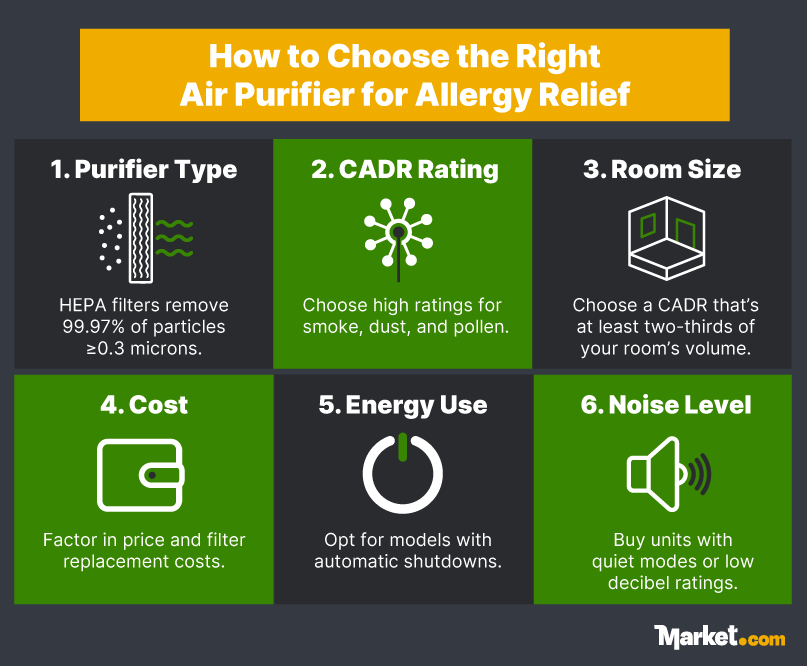
According to numerous experts, including those at the American College of Allergy, Asthma, and Immunology, it’s best for people with allergies to use air purifiers with HEPA filters at home.
True HEPA filters have been certified to remove 99.97% of pollutants as small as 0.3 microns. Devices listed as “HEPA-like” or a variation of this term mean they have not met the standard of a true HEPA filter.
The Environmental Protection Agency (EPA) recommends choosing an air purifier that doesn’t produce ozone. Some devices—like UV Air purifiers and air ionizers—release ozone as a byproduct, which can worsen asthma symptoms and even cause lung disease.
2. Rating
The clean air delivery rate (CADR) measures the effectiveness of an air purifier, expressed in cubic feet per minute (cfm). The rating is set by the Association of Home Appliance Manufacturers (AHAM).
A 300 CADR means the unit can clean 300 cubic feet of air per minute. The higher the number, the faster it can filter the air.
One thing to note is that CADR is pollutant-specific: there are different limits to how much an air purifier can filter either smoke, dust, or pollen. For example, the maximum CADR rating for dust is 400, while the maximum for smoke and pollen is 450.
3. Room size
The rating of the air purifier you choose should be appropriate for the size of the room you’re going to use it in.
As a general rule, pick an air purifier with a CADR that’s at least two-thirds of the room’s square footage for optimal performance. For example, a 150-square-foot room requires a unit with at least 100 CADR.
4. Cost
An air purifier’s price is important, but you also need to factor in the ongoing cost of filter replacements and servicing.
Most filters need to be changed annually, but this also depends on the air quality where you live and how often you use your device. This can add up quickly if you choose a unit that uses expensive filters or can only be serviced by certain technicians.
5. Energy consumption
Energy consumption is another factor to consider, especially if you need to run your unit for long periods.
Check the energy efficiency ratings on your preferred unit and choose one that consumes less power to keep your energy bills down. You may also want to find a model that switches to standby mode when the air quality reaches a certain level.
6. Noise level
Pick a unit that doesn’t make too much noise when it’s operating, especially if you’re going to use it in your bedroom or another area where you need peace and quiet.
Typically, air purifiers produce noise levels between 35 and 70 decibels (dB). This means they can be as quiet as the hum of your refrigerator or even as loud as the whizz of your vacuum cleaner.
Look for models that allow you to adjust the fan speed, offer a sleep mode, or have a low dB rating, especially if you’re planning on using it overnight.
7. Smart Features
Smart features provide convenience and give you more control over your device. These might include programmable timers, automatic shut-off, smart home integration, voice command, and a centralized app to adjust settings and program your air purifier.
Common Mistakes When Using An Air Purifier
Once you’ve purchased an air purifier, you’ll need to use and maintain it properly to ensure it works optimally and lasts longer.
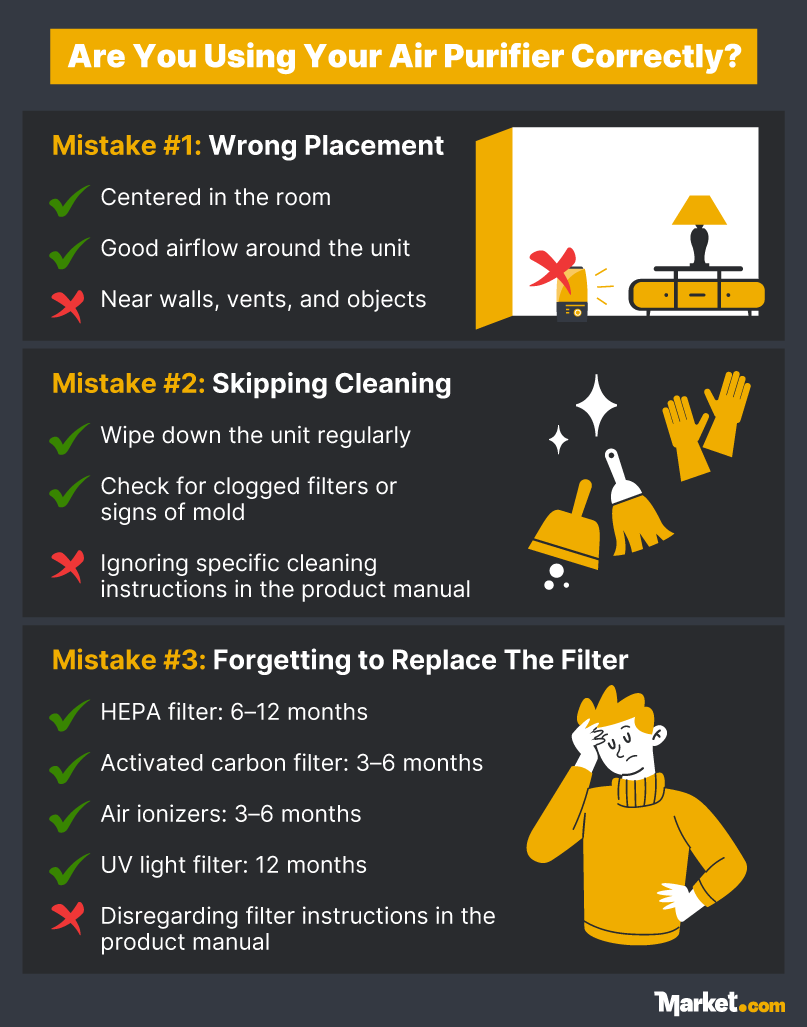
A common mistake is poor placement. For best results, place your air purifier in the centre of a room, away from walls, furniture, and vents to allow optimum airflow.
Some people may overlook regular cleaning, but it’s essential to keep your air purifier working effectively. Wipe down the unit and the surrounding area, check for clogged filters, and wash the filters if required.
Another common oversight is forgetting to replace the filters on time. As a general guideline, replace HEPA filters every 6–12 months, activated carbon every 3–6 months, air ionizers every 3–6 months, and UV light filters every 12 months.
The Bottom Line
Allergens from dust mites, cockroaches, mold, dust, and pollen can cause a range of allergy symptoms that can be life-threatening. Indoor air pollutants such as VOCs, smoke, ozone, and other harmful gases can also trigger or worsen allergic reactions.
Air purifiers help remove airborne allergens and improve air quality in your home. Studies and recommendations from experts suggest that people with allergies should use HEPA air purifiers. When choosing an air purifier, consider factors such as the CADR, room size, cost, smart features, noise level, and energy efficiency.
However, an air purifier alone isn’t enough. As part of an allergy management strategy, you must establish a regular cleaning routine, maintain optimal humidity levels, improve ventilation, and opt for allergy-friendly materials, furniture, and flooring.
All of this keeps you healthy and creates a comfortable space at home—one that you can truly call a sanctuary.