
















![[First Draft] - Online shopping (clothes) buying guide](https://www.market.com/wp-content/uploads/2026/01/-first-draft---online-shopping-clothes-buying-guide-1.png)
A Guide to Online Clothes Shopping
When shopping for clothes today, you can browse thousands of styles, compare prices in seconds, and get everything delivered to your door — all without leaving the comfort of your couch. The global market for online fashion and apparel retail is estimated to have reached roughly $900 billion in 2025. According to consumer research published by Salsify, this was driven mainly by convenience (the top reason for 71% of people) and better prices (64%).
Even so, online clothes shopping isn’t perfect. Sizing can feel like a guessing game, photos can be misleading, and the number of choices can be overwhelming. When taken together, these issues help explain why clothing has more returned items than any other product category.
This guide will help you make better informed decisions when you’re shopping for clothes online so that you can plan your purchases strategically, work out sizing charts, spot quality options, choose reliable retailers, and avoid common mistakes. Turn online shopping from a gamble into something that actually works for your style, budget, and lifestyle.
Assessing Your Needs and Setting the Stage
Shopping for clothes online can be overwhelming, with your screen flooded with new choices after every click and scroll. You might think the solution is to just pick the right size or find a good deal, but the real secret to success starts long before you add anything to your cart.
Tips for Effective Mindful Clothes Shopping
The most common reason for regretting a purchase is straightforward — it was an impulse buy driven by emotions rather than need. When the rush you get from hitting the buy button fades, it’s replaced with buyer’s remorse.
Planning your purchases a little more mindfully can help break this cycle. And mindful shopping doesn’t start when you open your browser — it starts in your closet.
First, you’ll want to sort what you already own into categories such as things you wear constantly, items that need replacing, seasonal items, and things you never touch. This way, you can spot gaps in your wardrobe and figure out what you actually need.
Then, ask yourself whether you’re shopping for everyday wear, work, special occasions, or specific activities. Something for your cousin’s wedding will require different thinking than building out your weekly rotation!
Define your personal style by identifying some key elements behind your clothing choices:
- Your preferred colors and color combinations
- Patterns and textures you gravitate toward
- Silhouettes that flatter your body shape and feel comfortable
- Style categories that resonate with you
- Your lifestyle needs — work requirements, climate, social activities, and daily routines
Once you’ve clarified your preferences, you can use the “Three Word Method” as popularized by stylists Allison Bornstein and Amy Smilovic. These words become your shopping filter, helping you skip items that don’t match your style.
Some stylists suggest assigning specific meanings to each word, such as baseline, aspirational, or emotional qualities (for example, you might label an item as “minimal, comfortable, and playful”).
Other stylists recommend that the first word be your favored style, the second word be a feeling you want to have, and the third word be what you want to project. This could result in something like “classic, glamorous, mysterious.”
Take your three favorite pieces from your closet and describe them with three keywords to get a feel for your existing preferences.
Then, set a realistic clothing budget, and use Cost Per Wear (CPW) to evaluate purchases. To measure CPW, divide the price of an item by how many times you expect to wear it. For instance, a $150 jacket worn 100 times costs $1.50 per wear, while a $50 impulse buy worn twice costs $25 per wear. The #100Wears Rule also simplifies your choice — if you can’t imagine wearing something at least 100 times, maybe you shouldn’t buy it.
Fashion icon Vivienne Westwood’s words are some to live by: “Buy less. Choose well. Make it last. Quality, not quantity. Everybody’s buying far too many clothes.”
Sizing, Fit, & Measurements
Different countries base their sizing systems on different body shapes, measurement methods, and historical norms.
- UK sizes tend to use inches and represent body measurements
- US sizes generally run two sizes above the UK sizes (a women’s US 6 equals roughly a UK 10)
- EU sizes use numeric labels starting from 32 upwards and are based on centimeters
- Asian sizes tend to run smaller than US sizes because close-fitting clothing is popular and people are generally more petite
Even if you don’t have international sizing variations to contend with, getting the right size online can feel like guesswork, and the numbers prove it. 53% of all apparel returns are due to size and fit issues, making it the number one reason clothes are sent back.
At the same time, 56% of shoppers admit to bracketing — ordering multiple sizes of the same item and returning what doesn’t fit. It’s not economical and leads to added waste, but the lack of standardized sizing across brands and countries, and the opacity of the true costs of clothing returns, often makes it seem like the most convenient option, especially if you’ve had bad luck with past orders.
Women’s International Size Conversion
Women’s sizing uses the same numbering system across all clothing types — dresses, tops, pants, and jeans all follow these conversions.
Men’s International Size Conversion (Tops & Shirts)
Men’s tops and shirts use chest measurements in inches. US and UK sizes are often identical (both use 34″, 36″, 38″, etc.), while EU adds 10 to the chest measurement.
Men’s International Size Conversion (Pants & Jeans)
Men’s pants use waist measurements as the primary sizing method.
Then there’s vanity sizing, which is when brands assign smaller size labels than actual measurements would indicate. Brands use this psychological trick to make customers feel better about themselves and increase purchases. Unfortunately, it creates major confusion across retailers — especially when shopping online.
Body Measurements or Garment Measurements
Charts show either your body measurements or the garment’s actual measurements, and mixing these up guarantees a poor fit. Body measurement charts tell you to measure yourself and match those numbers to a size. Garment measurement charts list the actual dimensions of the clothing item itself.
A savvy move is to measure a similar item you already own that fits well, then compare those measurements to the garment chart.
Fabric Choice
Stretch fabrics (like lycra and spandex) have flexible fits — often being able to accommodate a couple sizes up or down, depending on your preference. Structured, woven fabrics with little to no stretch have more defined fits and follow exact measurements. This is why some retailers use letter sizes (S, M, L) for stretchy items and numeric sizes (6, 8, 10) for structured pieces.
How to Measure Yourself Accurately
Grab a flexible fabric measuring tape (not metal), and follow this advice:
- For women: Key measurements include bust circumference (around the fullest part), waist circumference (narrowest part of your torso — you can bend sideways to help find the crease), hip circumference (including the fullest part of your bottom), and inseam (crotch to bottom of the ankle bone).
- For men: Essential measurements include neck circumference (base of neck), chest circumference (under armpits at widest point, tape raised slightly over shoulder blades), waist (narrowest point), hip circumference (fullest part), inseam (crotch to bottom of the ankle bone), shoulder width (across back from shoulder to shoulder), and sleeve length (shoulder to wrist with arm bent).
Record measurements in both centimeters and inches to easily compare against international charts.
Technology That Helps Your Fit
You can use the following apps to measure yourself, convert international sizes, find a good fit, and get sizing advice for various brands:
- Fytted (iOS and Android): Get precise body measurements, styling advice powered by AI, and experiment with virtual try-ons.
- Mirrorsize (iOS and Android): Get precise 3D body measurements and instant size recommendations for clothing brands in just 17 seconds using your smartphone camera.
- Tailor Body Measurements by DM (iOS): Take, store, and send your clothing measurements anywhere with an easy interactive guide and share them in PDF or CSV format.
- Size Chart Pro (iOS and Android): Covers men’s and women’s clothing and shoes across the US, UK, EU, Japan, Korea, and Russia.
Some retailers offer their own virtual fitting technology. For instance, ASOS provides virtual try-on with body measurement scanning and a 3D avatar of you wearing your clothes of choice.
Materials, Construction, & Quality Indicators
When you can’t touch fabric or inspect seams in person, you need to become a detective with product descriptions, photos, and pricing. Here’s how to spot quality — and avoid junk — before you buy.
Decode Fabric Descriptions
Quality brands list specific details like “100% cotton,” “silk charmeuse,” or “80% wool, 20% nylon.” Vague terms like “premium fabric” or “synthetic blend” without percentages are often a sign of lower quality. Here’s what different fabrics offer:
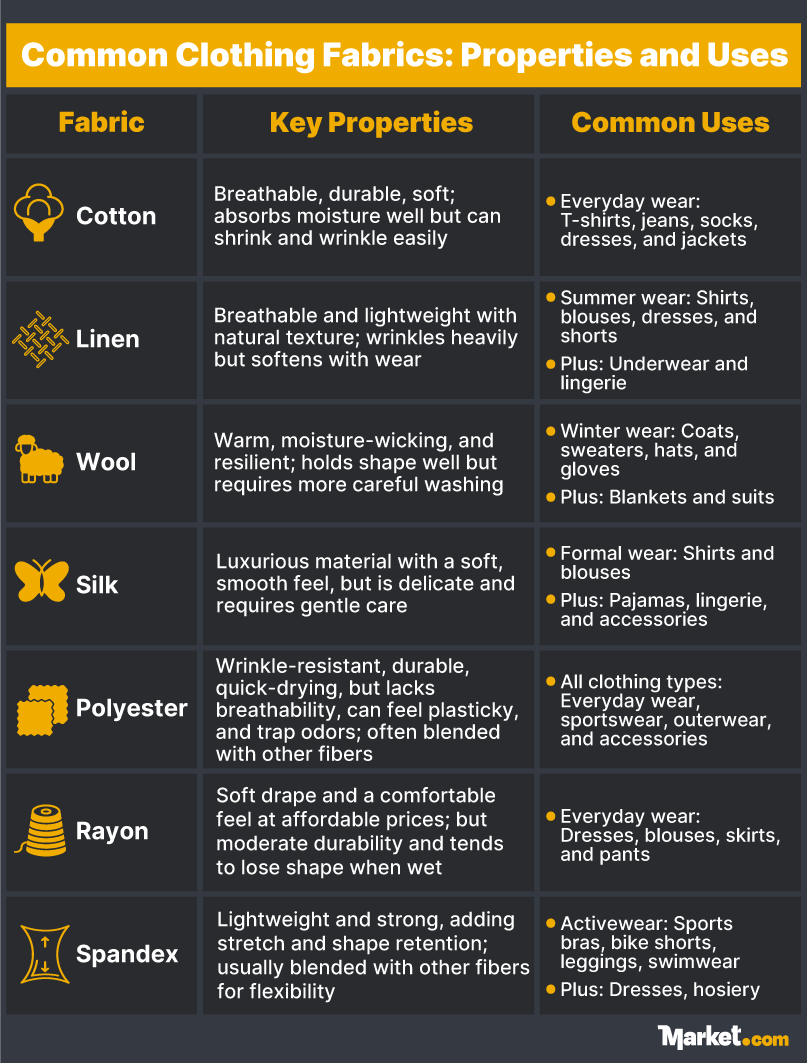
Fabric weight (measured in grams per square meter or GSM) correlates with the durability of a piece. Quality cotton should hit 180–300 GSM, hoodies 280–400 GSM, and denim 350–450 GSM. Fabrics with lower GSM numbers can feel thin and cheap.
Also, pay attention to certifications like OEKO-TEX (no harmful chemicals) and GOTS (requires 70%+ organic fibers and safe production).
Analyze Product Photos
When examining product photos, look for these quality indicators:
- Seams and stitching: Seams and stitches will be tight and even, without loose threads or wonky seams.
- Pattern alignment: On prints and stripes, quality garments match patterns at seams.
- Buttonholes: Buttonholes should be neat without loose threads or fraying edges.
- Hardware quality: Look for metal zippers that lie flat and buttons that are evenly spaced; plastic hardware wears out faster.
- Pockets: Pockets should be functional and have reinforced openings and stitching.
- Lining: Jackets, coats, and structured dresses should be lined; check if the lining matches the garment’s care code.
- Fabric drape: Fabric should fall so that it conforms to the body’s shape through its own weight, creating smooth, natural lines rather than appearing awkward and stiff.
- Texture visibility: Zoom in on product photos to spot the telltale signs of quality fabric. If the material gleams like cheap plastic under studio lights… that’s a red flag.
- Beware misleading photos: Lighting and color manipulation can make items look different than in person, and AI-generated images are becoming increasingly common.
- Seek out customer photos: Reviews with photos are much more likely to show a realistic representation of the item.
Price as a Quality Signal
Ultra-low prices usually mean cheap fabrics or sloppy stitching, although high prices don’t guarantee quality.
Prices can vary dramatically by item. A quality t-shirt might be $30–50, while a quality winter coat starts around $150–200. If a price seems unusually low compared to similar items from other retailers, there’s a good chance it’s cutting corners on materials or construction.
Brand reputation is also worth considering. Established brands with consistent records of high quality provide more reliable purchases than unknown sellers, even at similar price points.
Match Quality to Your Needs
Different purposes demand different standards. Workwear needs sturdy fabrics that handle frequent washing. Special occasions may call for luxurious materials and complex cuts. Everyday clothes need comfort and sturdy construction. Activewear demands stretch and moisture-wicking fabrics.
Whatever the occasion, consider what you want out of the new clothes you’re after.
Colors, Style, & Coordination
You can create a cohesive closet where everything plays nicely together by choosing colors that actually work for you (and your existing wardrobe).
Choose Colors That Complement Your Skin Tone
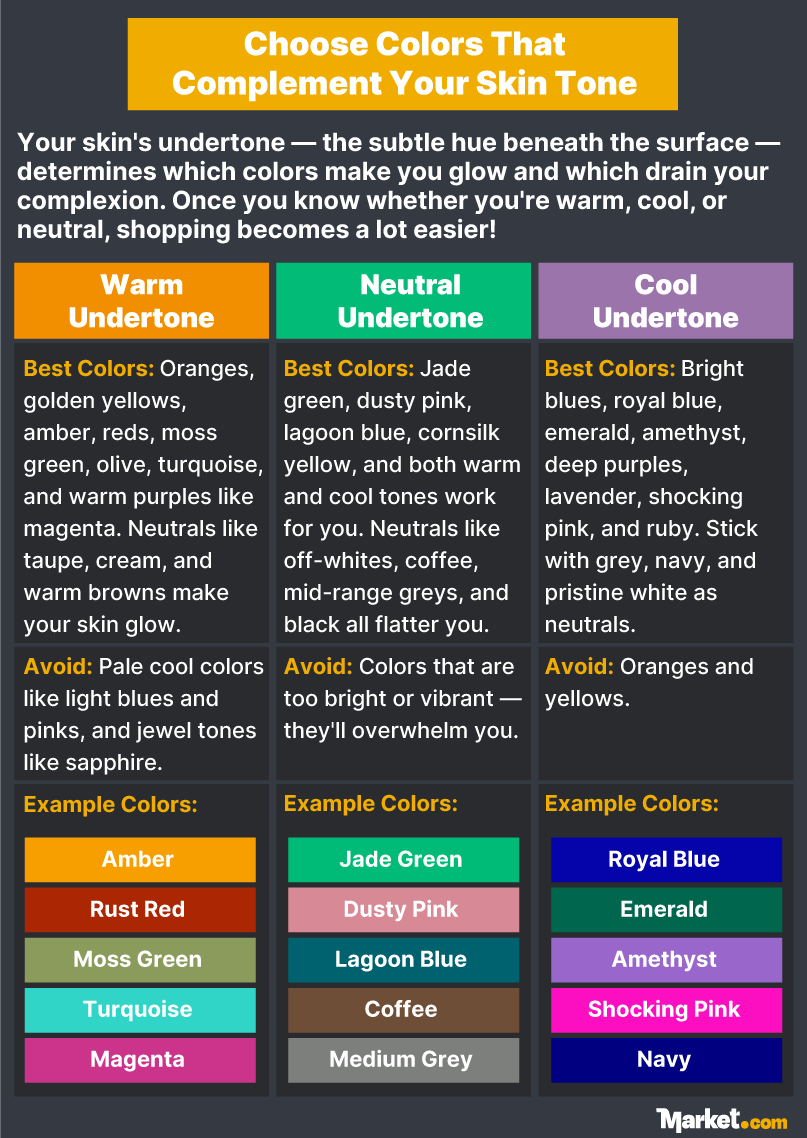
Your skin’s undertone — the subtle hue just under the surface — dictates which colors enhance your natural complexion rather than drain it.
Two quick tests help reveal your undertone. First, hold white paper against your face in daylight and see whether your skin leans golden-yellow (warm), pink-blue (cool), or somewhere in between (neutral). You can also check the veins on your wrist. Greenish tints signal warm undertones, bluish-purple suggests cool, and difficulty distinguishing means neutral.
Warm undertones: Choose oranges, golden yellows, amber, reds, moss green, olive, turquoise, and warm purples like magenta. Neutrals like taupe, cream, and warm browns make your skin glow. Avoid icy shades and jewel tones like sapphire.
Cool undertones: Your best colors are bright blues, royal blue, emerald, amethyst, deep purples, lavender, shocking pink (not hot pink), and ruby. Stick with grey, navy, and pristine white as neutrals, but skip oranges and yellows.
Neutral undertones: You’re lucky — you can wear both warm and cool tones! Jade green, dusty pink, lagoon blue, cornsilk yellow, off-whites, coffee, mid-range greys, and black all work. Avoid colors that are too bright or vibrant as they’ll overwhelm you.
Build a Capsule Wardrobe
A capsule wardrobe is a curated collection of high-quality, timeless pieces chosen for their versatility and ability to be mixed and matched, based on your lifestyle, color pallet, and body type. Long-term, it will help you save money, choose outfits more easily, and allow you to make better purchases that fit your look and don’t go to waste.
Some examples of these “timeless” pieces could include:
- Neutral t-shirts and tanks (5–7)
- Versatile bottoms like straight-leg jeans, trousers, and shorts (5–7)
- Layering knits and sweaters (3–5)
- Button-down shirts and blouses (3–5)
- Timeless outerwear like blazers and coats (3–5)
- Dresses if you wear them (2–3)
- Quality shoes (4–5 pairs, including sneakers, boots, and flats)
- 4–6 accessories (belts, bags, simple jewelry)
Choose a consistent color palette for your wardrobe. To get started, pick 2–3 neutral base colors, 2–3 complementary colors that match your skin’s undertone, and a final couple of accent colors to give your outfits a little extra pop. Round it off with a couple of patterned pieces, and you’ve now got a capsule wardrobe where things work together effortlessly.
Choosing the Right Retailer & Online Shopping Best Practices
To shop for clothes online, you need to know which retailers to trust, when to buy, how to spot red flags, and what mistakes to avoid. Here’s your essential checklist:
- Check URL security: Look for the padlock icon and “https://” in the URL to ensure the site connection is secured. Avoid clicking search engine ads so you don’t end up on a scam site (type the URL out manually if you know it or bookmark your favorite sites).
- Review payment methods: Trustworthy sites accept credit cards, digital wallets (PayPal, Apple Pay), and “Buy Now Pay Later” services. Avoid sites demanding wire transfers, gift cards, or cryptocurrency as these can be red flags.
- Run verification checks: If you’re unsure, use UrlVoid.com or Google Transparency Report to check the status of suspicious sites.
- Verify contact information: Legitimate retailers display a physical address, customer service email, phone number, and live chat. Real companies should have a genuine headquarters address and respond to you professionally.
- Spot fake reviews: Watch for bursts of reviews in short periods, repetitive language, reviewers with no history, all five-star ratings, and AI-style copy (repetitive, vague, and cliched language).
- Cross-check reviews: Compare ratings on multiple platforms (Trustpilot, social media, Consumer Reports) and prioritize “verified purchase” tags.
- Time purchases strategically: Shop in January (post-holiday clearance), July (mid-year sales), and November (Black Friday/Cyber Monday) for the best deals. March, July, and September can also be a good time to look as it’s when retailers clear inventory between seasons.
- Shop on Thursdays: Many retailers will release new markdowns before the weekend.
- Filter deliberately: Narrow by size, fit, color, price, and material to avoid endless scrolling.
- Sort strategically: Use “customer ratings” when you know what you want; browse “new arrivals” for inspiration.
- Prioritize customer photos: User-generated images show fits on “regular” bodies, not just models or edited images.
- Combine sizing resources: Match brand size charts with reviewer measurements for accurate predictions.
- Prepare for returns: Keep tags attached, photograph items when they arrive, save return labels, and set calendar reminders for deadlines.
Check Return Policies
A fair return policy should clearly state:
- Return window: Look for at least 30 days from delivery date (not purchase date).
- Return shipping costs: Know whether you or the retailer pays.
- Refund method: Confirm if you’ll get money back to your original payment method, store credit, or exchange only.
- Item condition requirements: Understand what “unworn with tags” actually means and which items are non-returnable (final sale, swimwear, undergarments).
- Processing time: Check how long refunds take to appear in your account.
Some retailers take customer-friendly policies to another level.
Nordstrom for example offers no time limit on returns, full refunds regardless of purchase date, free return shipping, and no receipt even required (if you’re willing to accept store credit).
Patagonia takes it further with their Ironclad Guarantee, accepting returns for store credit on worn gear that hasn’t met expectations. They even emphasize repairs over replacements to support sustainability, and will repair many items for free — you only have to cover shipping costs. These policies show what truly customer-focused return experiences look like.
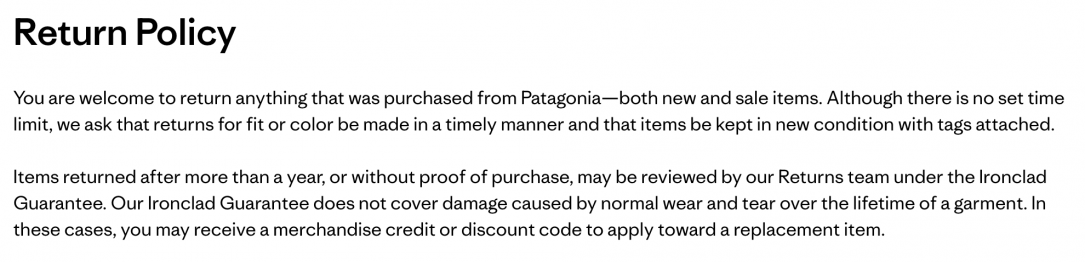
Source: Patagonia
Making Sustainable & Smart Choices
Every clothing purchase carries hidden costs beyond the price tag. The fast fashion industry is responsible for roughly 10% of global carbon emissions. This is more than all international flights and maritime shipping combined.
Returns only make this worse. A 2022 Optoro study showed that up to 24 million metric tons of CO2 emissions come from e-commerce returns annually, with a frightening 9.5 billion pounds (4.3 billion kg) of returned items sent directly to US landfills in 2022.
Fast vs. Slow Fashion
The rise of ultra-fast fashion is one factor that has pushed apparel emissions up 7.5% in 2023 to 944 million tonnes. This stems largely from churning out cheap virgin polyester garments designed to be worn only a handful of times before being replaced. Producing one pair of jeans uses 1,800 gallons of water, while washing synthetic garments releases microplastics that now comprise up to 35% of ocean microplastic pollution.
On the other hand, slow fashion prioritizes quality and durability over disposability. Brands leaning into this model prove that fashion can respect both workers and ecosystems. These include Pact’s organic cotton basics and Kotn’s community-focused Egyptian cotton. As we discussed earlier, look for certifications that signal genuine commitment, like GOTS, OEKO-TEX, or Fairtrade.
As Eco-Age co-founder Livia Firth said: “Fast fashion is like fast food. After the sugar rush, it just leaves a bad taste in your mouth.”
Financial Sense
Perhaps surprisingly, sustainability can be good for your wallet. 2024 data from Vestiaire Collective showed that pre-owned coats cost $1.72 per wear on average versus $4.82 for fast-fashion equivalents, while pre-owned designer dresses run $1.56 per wear compared to $5.66 for fast fashion.
According to data from ThredUp, America’s secondhand market grew 14% in 2024 — five times faster than traditional retail. Meanwhile, one study has found that thrift shopping slashes carbon emissions by up to 90% per item. It seems that more of the public is coming around to the idea that thrifting can work for them. And even small changes in your purchasing habits can show brands what you value and help reshape the industry.
Shop Intentionally, Dress Confidently
Online clothes shopping doesn’t have to feel like a gamble. Armed with the strategies in this guide, you can make it a convenient, cost-effective way to build a wardrobe you’ll actually wear.
Just remember that every purchase carries power. Where possible, choose quality over quantity, support ethical brands, and embrace secondhand options to reduce your environmental footprint while saving money through better cost-per-wear. You’ll spend less time managing returns and less money on pieces you don’t wear, and have more time and energy to simply enjoy clothes that fit you and your values.