









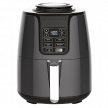






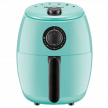
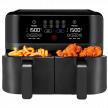
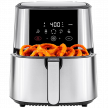
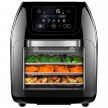
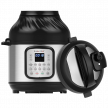

Air fryers come in all shapes and sizes, but if space is tight, a compact model will do the heavy lifting in the kitchen. These smaller air fryers are ideal for studio apartments or cramped kitchens, especially if you’re cooking for one.
The key is choosing one that balances size with enough power and temperature range to stay useful long-term. This guide walks you through everything you need to know to choose a quality compact air fryer.
Quick Answer: Who Should Buy What?
- Cooking for one in a small kitchen or dorm? Choose a 3–4 quart compact basket-style model.
- Extremely tight counter space? Look for a 2–3 quart mini model under 11 inches wide.
- Want better crisping and flexibility? Get as close to 4 quarts and 450°F as possible.
- Worried about overheating in very small units? Avoid ultra-high wattage in 1–2 quart models.
- Want smart features in a small footprint? Consider compact models with app or voice integration.
How To Choose a Compact Air Fryer
Capacity
Compact models usually range from 2 to 4 quarts.
A 4-quart model:
- Can cook a burger or chicken breast comfortably
- May fit nuggets and fries together
- Still requires single-layer cooking for best results
A 2–3 quart model:
- Is better for single servings
- Limits side + protein combinations
- May feel restrictive over time
One-quart models exist, but at that size, you’re mostly limited to reheating or very small portions. If you’re choosing between a 2-quart and 4-quart model, the 4-quart option will give you noticeably more flexibility without taking up dramatically more space.
If your kitchen allows it, go as close to 4 quarts as possible.
Temperature
One reason to consider going as big as possible within the four-quart limit is that you’ll get a wider temperature range. Most compact air fryers won’t go very low, so “low and slow” recipes like beef jerky or dehydrated fruit are off the table—the lowest temperature for these models is usually 170°F / 77°C. Read about models that can support dehydrating in my main air fryer guide.
Look for models closer to four quarts if you want higher heat. These are more likely to reach 450°F / 233°C, while smaller models often max out around 400°F / 205°C. If you find a smaller unit that claims higher temperatures, check reviews carefully for fire-related or overheating issues.
It might seem minor since many recipes cook between 350–400°F, but the difference can affect how crispy your food gets. If crispiness matters, make sure your air fryer can reach 450°F / 233°C.
Wattage
In larger air fryers, more wattage generally means better performance. In compact models, wattage needs to be balanced with safety.
Most compact units fall between 900W and 1500W.
For 3–4 quart models:
- 1200–1500W is typical and safe.
For 1–2 quart models:
- Stay closer to 900–1000W
- Extremely high wattage in tiny units can cause overheating or smoking issues.
Controls
Compact air fryers are intentionally simple.
Most include:
- Air fry
- Roast
- Reheat
- Basic preset buttons
You likely won’t find:
- Extensive preset libraries
- Multi-stage cooking
- Advanced programming
What matters most is this:
- Can you manually set the temperature?
- Can you adjust time precisely?
Capacitive buttons with digital readouts are usually easier to fine-tune than analog dials. Avoid models that lock you into preset-only temperatures with no manual control.
Build
Since compact air fryers are essentially small basket-style models, their build is generally similar. They include a pull-out basket with a crisper plate that lifts food off the bottom to allow air circulation. The casing—apart from the basket and crisper plate—is often made of plastic, which may increase exposure to PFAS compared with some other types of air fryers.
Look for the following when evaluating a compact model:
- Ensure the basket and crisper plate are dishwasher safe.
- Check that the basket is BPA-free, as this is the part that comes into direct contact with food.
Because these air fryers are usually on the cheaper side, some build compromises are possible. Lower-end models may have loose dials or handles, issues with smoking, or surfaces that get uncomfortably hot. While research is important for any air fryer, smaller models deserve extra scrutiny to ensure safety and durability.
What to Avoid
User reviews are especially useful for spotting long-term issues that professional reviewers may miss. With compact air fryers, watch for:
- Overheating or fire hazards—small devices generate significant heat in limited space.
- Cheap or unknown brands—these models may lack safety features and long-term durability.
Even well-known brands can occasionally produce faulty models, so careful attention to reviews is essential.
Brands
The most established brands for compact air fryers are Ninja, Instant, and Cosori, each offering multiple models that are well-reviewed.
- Ninja: Known for reliable performance and solid build quality, Ninja’s compact air fryers often feature simple, intuitive controls and consistent cooking results. They tend to balance size, power, and features effectively, making them a safe choice for buyers who want dependable results without a lot of extra bells and whistles.
- Instant: Instant’s compact models benefit from the brand’s experience with multi-cookers and air fryers. They typically have user-friendly presets, decent temperature ranges, and a variety of sizes within the two- to four-quart range. Instant models are often priced competitively, making them attractive for first-time buyers.
- Cosori: Cosori offers a strong selection of compact air fryers with innovative features, such as smart connectivity and voice assistant integration. Their compact units often hit the sweet spot between affordability and advanced functionality, and user reviews tend to highlight reliability and ease of cleaning.
Other well-known brands, like Chefman, Cuisinart, and Philips, generally offer only a single compact model. These may still be solid options but are more limited in variety, and pricing can be slightly higher compared with the top three brands.
You’ll also encounter many lesser-known brands—such as Elite Gourmet, Topzee, or Cosmo—particularly if you’re looking for ultra-small models or lower price points.
While some of these units perform well, others can be hit-or-miss in terms of build quality and safety, so careful attention to user reviews is crucial.
In general, established brands tend to provide better customer support and warranties, which can be a significant advantage if any issues arise.