





















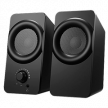




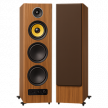
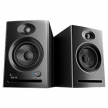

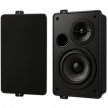


Active bookshelf speakers are designed for people who want strong sound without building a full hi-fi stack. With amplification built in, they remove the need for a separate receiver or amp, making them one of the simplest ways to upgrade your desk, living room, or TV audio.
But convenience doesn’t mean all models are the same. Connectivity options, streaming support, TV integration, room size, and expansion features like subwoofer outputs all affect whether a pair will truly fit your setup.
This guide walks you through the decisions that matter most so you can choose active bookshelf speakers that match your space, your sources, and how you actually listen.
If you’re still deciding between active and passive designs, or want a broader overview of speaker types, see our complete Speaker Buying Guide for a full breakdown of system options, room matching, and setup considerations.
Quick Answer: How Do You Choose Active or Powered Bookshelf Speakers?
Choose active or powered bookshelf speakers based on room size, connectivity, and how you plan to use them. For desks or small rooms, compact models with 30–50W per channel are usually sufficient.
If you’re connecting to a TV, look for HDMI ARC. For streaming, prioritize Wi-Fi over basic Bluetooth, and ensure the DAC supports at least 24-bit/96kHz for high-resolution audio.
If deeper bass matters, confirm the speakers include a dedicated subwoofer output.
Placement Considerations
Active bookshelf speakers perform best when properly positioned. Even the best model will sound underwhelming if boxed into shelving or pushed into corners. Avoid corners, give them space on a shelf, and experiment with their distance from walls, especially if they feature rear-firing bass reflex ports.
Benchmarks:
- Leave at least 15–20 cm between the speaker and walls.
- Avoid boxing speakers in with books or other objects on shelves.
- Use stands or decoupling pads to minimize contact with surfaces.
Also, audition speakers with and without grilles, as the difference in sound quality can be significant. Decide whether you can live with the aesthetic of the speakers “undressed.” Smaller rooms (desks, bedrooms, apartments) are ideal environments. Larger spaces may require higher output models or the addition of a subwoofer.
Active vs Powered: What’s the Difference?
The terms are often used interchangeably, but they are technically different.
A powered speaker amplifies the signal first and then divides frequencies between drivers using a crossover. Typically, one speaker houses all amplification and powers the second speaker via a cable. Only one cabinet requires a mains connection.
An active speaker sends the signal through the crossover before amplification. Each driver has its own dedicated amplifier channel. This allows for more precise control and potentially better performance — but also increases cost and complexity.
Because both cabinets contain amplification in a true active system, both require mains power. Placement flexibility may therefore depend on socket access.
What this means for you:
If simplicity and fewer cables matter most, powered designs are convenient. If performance and driver control are the priority, active designs may justify the higher price. You can learn more about when to choose one over the other in my guide to speaker types.
Integrated Amplification: Why It Simplifies Everything
Because amplification is built in and tuned specifically for the drivers, you don’t need to worry about impedance matching, sensitivity ratings, or amplifier compatibility like you do with passive bookshelf speakers; The manufacturer has already optimized the system.
That makes active and powered speakers especially appealing if you want strong sound without system-building complexity.
Connectivity and Inputs: Future-Proofing Your Setup
One speaker handles all physical and wireless inputs. Make sure it supports everything you plan to connect — now and later.
Bluetooth
Most affordable powered speakers include Bluetooth. Look for:
- Bluetooth 5.0 or newer (current standard is 5.4)
- High-quality codecs such as aptX, aptX HD, or aptX Lossless
Older Bluetooth standards (below 4.0) should be avoided.
Learn how to set up Bluetooth speakers in this guide.
Wi-Fi Streaming
Higher-end active speakers often include Wi-Fi. This allows:
- Higher-quality wireless streaming
- Multi-room compatibility
- Direct streaming service integration
- Phone-free playback via control apps
If you stream frequently, Wi-Fi is a meaningful upgrade over Bluetooth.
HDMI ARC (For TV Use)
Some active designs include HDMI ARC, allowing your speakers to function like a stereo soundbar alternative. If you want better TV sound without a full surround system, this feature is worth prioritizing.
Physical Inputs to Consider
- Phono input (for turntables without built-in preamps)
- Optical or coaxial digital inputs
- RCA or 3.5mm analogue inputs
- Subwoofer output
Think about every source you use: TV, record player, console, CD player, laptop, etc.
DAC Quality: Don’t Overlook Digital Processing
If you stream music — especially from high-resolution services — your speakers’ built-in DAC (digital-to-analogue converter) matters.
While CD quality is 16-bit/44.1kHz, many services offer higher resolution audio. Look for DAC support of at least 24-bit/96kHz. This ensures compatibility with most high-resolution streaming content and future-proofs your setup.
Listening and Performance Expectations
Small active or powered speakers cannot replicate the bass depth or scale of large floorstanders, but they should provide:
- Clear midrange detail
- Natural-sounding highs
- Adequate dynamic range
- Rhythmic accuracy
Play a variety of music at realistic volumes and listen for clarity, instrument separation, and tonal balance. Compare with known references if possible.
Should You Add a Subwoofer?
If you enjoy deeper bass, watch films frequently, or listen at higher volumes, a subwoofer can transform performance.
Check that your speakers include a dedicated subwoofer output. Not all models do.
In small rooms, a sub may be unnecessary. In medium-sized rooms, it often completes the system.