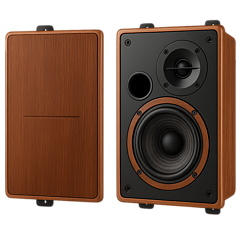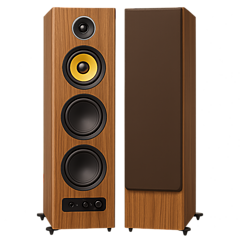















Most speakers look similar on the outside, but what’s inside makes a big difference in how they perform and how you use them. The key distinction comes down to one thing: where the power and control come from.
Active and passive speakers solve the same problem—producing sound—but they do it in very different ways. Understanding that difference helps you avoid overcomplicating your setup or, just as importantly, underbuilding it for your space.
This guide breaks it down clearly so you can choose the right option for your desk, home theatre, or listening setup.
Quick Answer: Active vs Passive Speakers Explained
Active speakers are those with built-in amplifiers, which allow them to work as standalone speakers. Passive speakers require a connection to an external amplifier/receiver for power, as well as additional features such as input switching and volume control.
Passive vs. Active Speakers: Key Differences
What Are Passive Speakers?
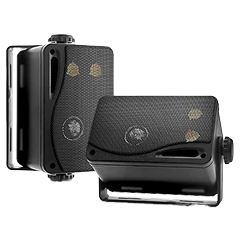
Passive speakers rely on an external amplifier or receiver to function. The amplifier sends a powered audio signal to the speakers, which then converts it into sound.
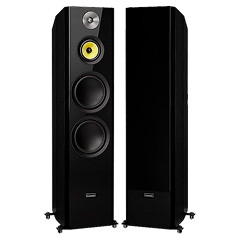
Inside, passive speakers are simpler. They typically include drivers (like woofers and tweeters) and a passive crossover that splits frequencies between them, but all power and control come from the external system. This separation is what allows passive setups to scale and be customized over time.
Learn more about the technical aspects of speakers, like drivers and crossovers, here.
What Are Active Speakers?
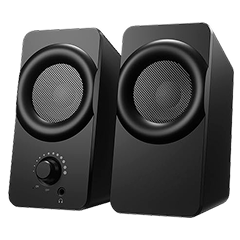
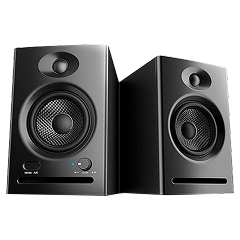
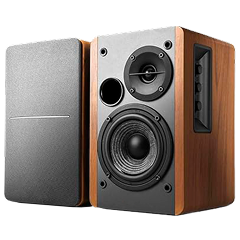
Active speakers (also called powered speakers) have everything built in. The amplifier, crossover, and sound tuning are all inside the speaker enclosure, so you don’t need extra equipment.
You simply connect a source—like a TV, laptop, or phone—and power the speaker.
This makes them ideal for setups where convenience matters. They’re commonly used for desks, small rooms, and casual listening because they work straight out of the box without needing technical setup.
Which Sounds Better?
There isn’t a universal winner: it depends on the setup.
Active speakers are tuned by the manufacturer to sound good immediately, which makes them reliable for most users. You don’t need to match components or adjust much to get solid performance.
Passive speakers, however, can outperform active speakers when paired with the right amplifier and proper setup. Because each component is separate, you have more control over sound quality, room tuning, and upgrades.
In simple terms:
- Active = consistent, easy performance
- Passive = higher potential with more effort
Best Choice by Use Case
Desk / Computer Setup
Active speakers are the better choice for nearfield listening. They’re compact, simple, and don’t require extra equipment cluttering your desk.
Home Theater
Passive speakers are the clear winner for full home theatre setups. They allow for proper surround sound configurations and better room coverage.
Active speakers can work in smaller setups, but they don’t scale as well for immersive audio.
Casual Music Listening
Both active and passive speakers are fine for casual music listening, but at higher volumes, passive speakers with the right amplifier are better for parties. For everyday listening, an active speaker is best because of its easier setup and automatic fine-tuning.
Audiophile / Hi-Fi Setup
Passive speakers are preferred here because they allow full control over amplification and sound tuning. This flexibility is what makes high-end systems possible.
Studio / Production
Active speakers are more convenient for home studios and music production because they don’t require pairing with precise external amplifiers. They deliver accurate responses across frequencies without requiring any matching and don’t need a power source for each speaker, unlike a passive speaker setup.
Cost Breakdown
Passive Setup Costs:
Passive setup costs vary with the number and price of components, but they’re generally more expensive upfront than active setups.
For a typical setup, you’ll need a compatible amplifier or receiver, the desired number of passive speakers (2 to 11+), audio cables, and an optional digital-to-analog converter.
The average setup costs $300-$2,000, but hi-fi audiophile systems can be as expensive as $5,000.
Active Setup Costs:
It’s easier to tell how much an active setup costs upfront because, unless you want an additional subwoofer for more bass, all you need to worry about is the cost of the speaker itself.
You can find an entry-level stereo speaker in the $100-$300 range, but mid-tier speakers can cost $300-$600. High-end speakers can cost as much as or even well over $1,000.
Set Up Comparison (Step-by-Step)
Although there are some nuances to consider when setting up active or passive speaker systems, below you’ll find a general step-by-step guide for both systems to help you get started.
Active Speaker Setup Guide
- Place the speakers next to each other, preferably at ear level and aiming toward you.
- Connect the speakers with the included cable
- Connect your audio source (3.5mm jack, USB, Optical, Bluetooth, etc.)
- Power both speakers on
- Set the desirable volume (avoid setting it too loud to prevent overload and distortion)
- Press play on your audio source device
- Adjust bass and treble as desired (if applicable)
Passive Speaker Setup Guide
- Position all speakers at an equal distance from each other if possible
- Set up the amplifier/receiver close to a power outlet and to all speakers for a stable wired connection
- Connect each speaker to the amplifier/receiver with the appropriate cables
- Connect your audio source to the amplifier
- Power on the amplifier
- Press play on your audio source device
- Adjust volume levels and fine-tune the EQ if desired
Upgrade & Longevity Comparison
This is one of the biggest long-term differences.
Active speakers are all-in-one units. If something fails, you usually replace the entire speaker.
Passive systems are modular. You can upgrade or replace individual components, including speakers, amplifiers, or sources, without rebuilding everything.
This means that passive setups are more future-proof, especially for enthusiasts.
Do You Need an Amplifier?
An active speaker does not require an amplifier because it’s built with all the necessary components. Passive speakers depend on external amplifiers for power and fine-tuning sound.
That means that while active speakers simply require a power source such as a wall outlet, passive speakers won’t work unless they’re hooked up to an amplifier or receiver.
Can You Mix Active and Passive Speakers?
Yes, you can mix active and passive speakers, but they usually need to be connected through a central device. This is because passive speakers require an amplifier, meaning you can’t wire them directly with active speakers.
A real concern is imbalance and inconsistent sound and volume, but this can be mitigated with a proper setup and correct matching between all components.
Generally, it’s best to choose one system over the other for simplicity and best sound performance. However, if you want an expandable system with active speakers, you can set it up with an AV receiver, which lets you connect multiple speakers and woofers.
Connectivity Differences
Passive speakers connect to amplifiers with 14-gauge or 16-gauge speaker wires. From there, it’s necessary to determine how to connect your audio source to the amplifier. Passive speakers cannot do this on their own — everything must run through the amplifier or receiver.
Active speakers are compatible with cables such as AUX, USB, and optical for sound output. Many also support Bluetooth for wireless playback, and unlike passive speakers, which require everything to run through the amplifier, you can usually hook up your audio device directly to an active speaker, press play, and you’re off.
Decision Guide: Passive or Active Speakers
Choose active speakers for:
- Desktop or PC setups
- Casual home listening
- Small-to-medium-sized indoor spaces
- Studio monitoring or music production
- Basic TV setups
- Portable or flexible setups
- Wi-Fi or Bluetooth streaming from a device
- Avoiding complex setups with amps, receivers or wiring
Choose passive speakers for:
- Home theaters
- Large indoor spaces
- Hi-Fi or audiophile setups
- Scalable modular components
- Multi-room speaker setups