











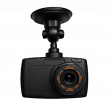
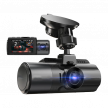
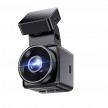
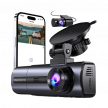
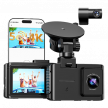


Depending on how they’re designed, dual-camera dash cams (also known as dual-channel dash cams) can watch the front, rear, or interior of your vehicle – but not all three. They either come with a separate camera for mounting at the back of the vehicle to create a rearview or an interior-facing camera integrated into the dashcam along with the front-facing camera and can capture video and photos of the cabin.
If you want to capture all three scenes – the front of your vehicle, behind it and what’s inside – you’ll need a three-camera or three-channel dash cam. Why would you need a rear-facing and interior-facing camera? There are several reasons.
Why Install a Third Interior Camera
If you’re a ride-share or commercial driver—for example, working for a transport or delivery company—having an interior-facing camera is essential, and in some cases, required. Many school districts now mandate that bus drivers use interior cameras to monitor passengers, discourage bullying, and provide evidence if an incident occurs.
Transportation companies often install both interior and exterior cameras for similar reasons: to improve safety for drivers and passengers, document what happens inside the vehicle, and assess driver performance.
For everyday drivers, interior cameras can also be useful. If your dash cam includes a parking mode, an interior lens can record break-ins or vandalism inside the cabin. During accidents, interior footage can help prove that you were attentive and not distracted, or even support injury claims—for example, showing how you moved during a collision. Some parents also use interior dash cams as a behavioral deterrent for kids while driving.
Before getting into the specifics of three-camera dash cams, there are two things to keep in mind. First, while some details overlap with dual-camera systems, the categories differ in both performance and features. Second, though a few four-channel dash cams exist—like the Vantrue Nexus 5 (adds a rear-interior camera), Rexing R4-RD (includes two side-facing cameras), and LAMTTO 360° View Dash Cam (front, rear, and two rotatable side cameras)—the key information below also applies to those more advanced setups.
Key Features
Image Sensor
Each camera in a dash cam system relies on an image sensor to convert incoming light into video or photos. Image sensors are especially critical for dash cams because they must capture fast-moving vehicles, stationary road signs, and other details in constantly changing lighting conditions.
A high-quality image sensor ensures sharp, clear footage day or night. Look for dash cams that use Sony’s STARVIS 2 sensors, which are designed for excellent low-light performance and accurate color reproduction. Some premium models, like the Vantrue N4 Pro S and Viofo A329S, use STARVIS 2 sensors on all three cameras. Others, such as the 70mai T800, use STARVIS 2 for the front and rear cameras and a different sensor for the interior one to balance performance with cost.
Two other important technologies that work alongside image sensors are Wide Dynamic Range (WDR) and High Dynamic Range (HDR).
- WDR is hardware-based. It captures several images at different exposures (useful during sunrise or sunset) and combines them into one balanced frame with visible detail in both bright and dark areas.
- HDR is software-based and expands brightness and color range for more natural tones and greater contrast in shadows and highlights.
Look for dash cams that include WDR or HDR support, as these features help maintain detail in challenging lighting. Some models include both, but many offer one or the other.
Resolution
Resolution determines how many pixels make up each video frame, and therefore how detailed and sharp your footage appears. Higher resolution means clearer videos, which is especially important if you need to identify a license plate after an incident.
Common dash cam resolutions include 720p (HD), 1080p (Full HD), 2K (Quad HD), and 4K (Ultra HD). Avoid 720p if possible, it’s too low for modern dash cams. Look for at least 1080p Full HD as a baseline for clarity, and go for 2K or 4K if you want to capture finer details at a distance or in low light.
Three-camera systems use multiple sensors, so they often record at different resolutions to balance quality, processing power, and cost. For example:
- The 70mai T80 records 4K on the front and rear cameras, and 1080p on the interior camera.
- The Vantrue N4 4K records 4K front, 1080p rear, and 2.5K interior.
Look for a system where the front camera records in the highest available resolution, since it captures the most critical footage. The rear and interior cameras can use slightly lower resolutions without major quality loss. Keep in mind that higher-resolution footage takes more storage space, so use high-capacity memory cards (64GB or higher) if your dash cam records in 2K or 4K.
Parking Mode
Parking mode allows your dash cam to monitor your vehicle when it’s parked and the ignition is off. To use this feature, the dash cam must have a constant power source, typically through a hardwiring kit connected to your car’s fuse box.
When activated, parking mode records incidents like impacts, motion near the vehicle, or even attempted break-ins. A three-camera dash cam offers the most comprehensive protection, since it can monitor the front, rear, and interior simultaneously.
To prevent draining your car battery, most dash cams switch into a low-power standby mode and wake up when triggered by:
- Impact detection (G-sensor): Starts recording when a collision or vibration is detected.
- Motion detection or radar sensors: Detects nearby movement and activates the cameras.
- Time-lapse mode: Takes photos every few seconds to create a condensed playback of parked activity.
Look for parking mode options that fit your needs. For example, if you park outdoors or overnight, choose a model with radar or AI motion detection that can distinguish between real threats (like someone trying to open the door) and minor movements (like passing pedestrians or blowing branches).
Some advanced models, such as the 70mai 4K T800, support AI-assisted parking mode and can connect to an optional cellular modem. This allows the dash cam to send alerts to your phone when an impact or motion is detected and even lets you view live footage remotely.
Installation
Installing a three-camera dash cam is slightly more complex than setting up a single or dual-camera model. Each camera must be positioned carefully to capture the right field of view:
- Front camera: Mounted behind the rearview mirror.
- Rear camera: Installed near the top of the rear window, with a power or signal cable routed to the main unit.
- Interior camera: Either built into the main body or mounted separately inside the cabin.
Look for a system with clear installation instructions, cable management accessories, and an included hardwire kit if you plan to use parking mode. Some brands provide adhesive mounts and detailed guides to help run cables cleanly along the headliner or under trim panels.
Storage and Memory Cards
Because three-camera dash cams record from multiple lenses at once, they generate a large amount of video data. Choosing the right memory card and understanding how storage affects performance is essential if you don’t want to lose critical footage.
Dash cams typically store recordings on microSD cards, which continuously loop and overwrite the oldest files once the card is full. To keep the process smooth, you need a card that can handle frequent, high-speed writing without corruption.
Look for cards labeled “High Endurance” or “Dash Cam Specific.” These are designed for constant recording and re-recording. Regular microSD cards wear out much faster and may fail without warning.
Key factors to consider:
- Capacity: A 64GB card is the minimum recommended for three-camera dash cams, but 128GB or 256GB gives you more retention time before old footage is overwritten—especially important for 2K and 4K recording.
- Speed Class: Check for U3 (UHS Speed Class 3) or V30 ratings or higher. These ensure stable 4K recording without dropped frames.
- File System: Many dash cams format cards as FAT32 or exFAT. Always format your card in the dash cam itself before first use to ensure compatibility.
- Brand and Reliability: Stick to reputable brands such as SanDisk High Endurance, Samsung PRO Endurance, Kingston Canvas Go! Plus, or Lexar High-Performance.
Look for models that support large-capacity microSD cards (up to 256GB or 512GB) if you want longer video retention or record in the highest resolutions. If your dash cam supports cloud backup or Wi-Fi transfer, consider setting it to automatically upload key events so you don’t lose them when the card loops over.
Finally, replace your memory card every 12–18 months if your dash cam is in daily use. Even high-endurance cards degrade over time, and replacing them regularly helps ensure your recordings stay intact when you need them most.