










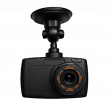
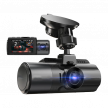
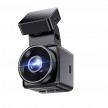
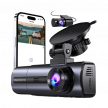
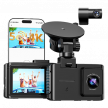


Sometimes less is more, and a smaller dash cam fills the bill if you want a device that’s compact and unobtrusive. Smaller size allows a dash cam to fit behind your rear-view mirror, for example, offering a less obstructed view of the road and making the dash cam less noticeable from both inside and outside.
Another advantage is that for drivers who frequently switch between vehicles a smaller dash cam can be more easily moved from vehicle to vehicle. For frequent travelers who want to take a dash cam with them, small dash cams are easier to pack and move between vehicles while traveling. On the downside, some smaller dash cams don’t have screens, so their controls can be harder to access, and some don’t offer the full features of larger dash cams.
When considering a small dash cam over a standard size device, here are features to look for and concerns to consider to help you decide and narrow down your choices.
Key Features of Small Dash Cams
Number of Channels
The first step to choosing any sized dash cam is determining how many cameras—or channels—you’ll need. Some small dash cams offer two channels with front and rear cameras or front and interior cameras, and a few have three cameras to monitor the front, rear, and interior of a vehicle.
When you’re comparing models, look for channel combinations that match your driving patterns. For example, a rideshare driver benefits from a front-and-interior setup, while daily commuters may prefer front-and-rear coverage. As a rule of thumb, look for systems that record both channels at a minimum of 1080p and can maintain at least 20–25 Mbps bitrate per channel.
Keep in mind that the number of channels correlates to the difficulty of installation and the overall cost of a small dash cam. Multi-channel systems will require more wiring, which means you should look for kits that include long enough cables, labeled connectors, and adhesive mounts that work with curved windshields.
Video Quality
While small dash cams can be mighty, they are not all created equal. For clear and detailed footage, look for a dash cam that records in at least 1080p video resolution, while 2.5K or 4K resolution is even better. Higher resolution becomes especially important if you want the camera to capture readable license plates at distances of 10–15 meters or more.
You should also check the bitrate; look for models offering at least 12–20 Mbps for 1080p and 30 Mbps or more for 4K so the footage stays sharp during motion.
The clarity of these details also depends on a dash cam’s image sensor. A Sony STARVIS 2 image sensor offers some of the highest quality available, but many small dash cams still rely on the first-generation Sony STARVIS sensor or other alternatives. Look for sensors with at least a 1/2.8-inch size, which improves dynamic range and reduces noise.
In addition to resolution quality, a wide-angle lens is an important feature to look out for when shopping for small dash cams. Wide-angle lenses offer more coverage, so look for a field of view (FOV) angle of at least 120 degrees but ideally 150 degrees or higher if you want coverage across multiple lanes. Keep in mind that the wider the FOV, the more the image becomes distorted, so check whether the camera offers distortion correction or allows you to adjust the FOV setting.
Low Light or Night Recording
A small dash cam that supports low light or night recording is essential for drivers who commute in the dark or need a parking mode to record incidents and protect a vehicle while you’re away. Look for models with infrared lighting, HDR or WDR recording, or enhanced night vision modes so the camera can maintain balanced exposure in dim environments.
It also helps to compare the camera’s night-time aperture rating. A lens with an f/1.6 or f/1.8 aperture will capture more light than models with an f/2.2 aperture. Look for night samples from the manufacturer or user reviews that show clear details under streetlights at typical driving speeds. If you drive on unlit or rural roads, prioritize a sensor that de-noises footage without smearing moving objects.
Storage Capacity
The size of the dash cam doesn’t affect its storage capacity. When shopping for a small dash cam, the same basic considerations outlined in the main Dash Cam Buyer’s Guide—such as SD card size, loop recording, and cloud/Wi-Fi connectivity—apply. The minimum recommended size is 64GB to 128GB, but you may want to choose a higher-capacity memory card from 256GB up to 512GB if you use a two- or three-channel dash cam that requires more storage space. As a rough estimate, a 4K front camera recording at 30 Mbps can fill 64GB in about three hours, so adjust your storage expectations based on resolution and bitrate.
When reviewing storage specs, look for U3 or V30-rated microSD cards to ensure they can handle constant recording without dropped frames. Dash cams that advertise “endurance” card compatibility are more reliable over time.
Alternatively, you could opt for a cloud-enabled small dash cam that uses Wi-Fi or LTE to upload footage. These offer access to video via a brand-specific smartphone app that relies on an LTE or Wi-Fi connection to upload footage. Look for models that support auto-upload of impact events and let you set upload quality (high or low resolution).
For peace of mind, these dash cams typically use local storage in addition to the cloud so video can be saved even when connection is lost. The downside is that cloud storage usually requires a subscription and the modem is also an add-on cost. If you choose LTE, check the estimated monthly data usage, which varies depending on how often events are uploaded.
Power Source
While small dash cams are ideal for moving from car to car, how you choose to power the dash cam will affect portability. The three main power sources for a small dash cam include the vehicle’s 12-volt cigarette lighter outlet, hardwiring, or an external battery pack.
For easy installation and maximum portability, using a 12-volt power source is ideal, but the camera will record only when the vehicle’s ignition is on. Look for models that support “auto-start” so recording begins as soon as power is detected. Using this power method, you simply route the power wire from the dash cam to the vehicle’s 12-volt outlet, although the cable will be visible. For a cleaner but less portable installation, you can route the power cable behind interior panels to the vehicle’s 12-volt outlet so it’s hidden.
Powering the dash cam via hardwiring will allow it to operate even when the car is turned off. This is important if you want a dash cam with parking mode. If you choose to hardwire, look for kits that include low-voltage cutoffs with adjustable thresholds (for example 11.8V, 12.0V, 12.2V) so you can protect your battery. Hardwiring also makes it more difficult to move a small dash cam between vehicles but offers less visual clutter.
For drivers who want the mobility of a small dash cam and need parking mode, adding a backup battery provides flexibility. The size and capability of backup batteries vary, so choose one that supports the power draw of your dash cam. As a rough guide, a 4000–6000 mAh battery can provide 10–20 hours of parking mode for a single-channel cam. The drawbacks of this power source include extra cost, the need to install the backup battery, and added charging time.
Additional Features
It’s important to note that while the reduced size provides mobility and discretion, the potential tradeoff can be a lack of features such as GPS tracking, Wi-Fi connectivity, and parking mode. Premium small dash cam companies will include some or all of these additional features, but this will be reflected in the price.
If you want GPS, look for systems that log speed and location directly onto the video file and provide downloadable route maps. For Wi-Fi, check whether the model uses 2.4 GHz or 5 GHz, since 5 GHz offers faster transfers for long clips. If parking mode is important to you, look for models offering buffered recording, which captures a few seconds before an impact, and adjustable sensitivity so you can prevent false alerts from rain or vibrations.
Choosing a Small Dash Cam With or Without a Screen
An important consideration when choosing a small dash cam is deciding whether a screen is important to you. Without a screen, you can mount your dash cam out of sight, which helps keep the windshield tidy and reduces distractions. If you choose a screenless model, look for cameras with reliable voice commands or a well-designed mobile app so you can adjust settings easily.
If you want a device with a screen for live view or video playback, look for at least a 2-inch display so menus remain readable. The onscreen controls on a small dash cam are usually smaller and more difficult to access compared to larger dash cams, so prioritize simple menu layouts and physical buttons that you can feel without looking away from the road. You can also check whether the screen automatically dims at night to avoid glare.
With Screen Without Screen