













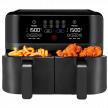
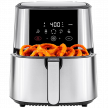
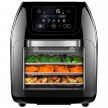
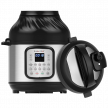

Dual air fryers have quickly become one of the most practical upgrades in home cooking. With two independent baskets, they let you prepare different foods at the same time, whether that’s chicken wings and fries or a main and a side dish. This flexibility saves time, reduces the need for multiple appliances, and makes it easier to serve complete meals at once.
In this guide, we’ll break down the key features to consider when choosing a dual air fryer, from basket size and cooking functions to performance benchmarks and ease of cleaning. By the end, you’ll have a clear sense of what to look for and which models might fit your cooking style best. My main air fryer buyer’s guide has more information about choosing air fryers overall.
Quick Answer: Who Should Buy What?
- Cooking for 2–4 people nightly? Get a 7–9 qt per basket dual model (14–18 qt total).
- Want easiest cleaning + simple operation? Choose a basket-style dual air fryer.
- Cooking full family meals or batch prep? Go with a toaster oven-style dual model (20+ qt).
- Limited counter width but tall cabinets? Consider a stacked (vertical) model.
- Want both sides to finish at the same time? Make sure it includes Sync or Match cooking mode.
- Care about dehydration or broiling? Check for a 130°F low end and 450°F high end.
How To Choose a Dual Air Fryer
Form Factor
Dual air fryers come in two main designs: basket-style and toaster oven-style (which is the biggest type of air fryer). Both have two independent cooking zones, but they offer very different experiences.
Basket-Style Dual Air Fryers
Choose this if:
- You want simple, everyday cooking
- You mostly cook proteins + sides
- You prefer easy cleanup
- You don’t need to stack trays
These are best for households that want speed and convenience. Each basket operates independently, and cleanup is usually as easy as removing and washing the baskets.
Skip this if:
- You bake often
- You cook large casseroles or sheet-pan meals
- You want multi-rack flexibility
Toaster Oven-Style Dual Air Fryers
Choose this if:
- You cook for 4–6+ people
- You bake, roast, or broil regularly
- You want to cook multiple trays at once
- You want more versatility beyond air frying
These models allow stacking trays and often give you more flexibility per compartment. Some models even offer uneven split compartments (larger + smaller), which can be useful if you typically cook one main dish and one side.
Skip this if:
- You have limited counter space
- You don’t want to wipe down an interior cavity
- You prefer fast, simple meals
Layout: Side-by-Side vs Stacked
This is often overlooked but very important.
Side-by-Side
- Wider footprint
- Lower overall height
- Easier to fit under cabinets
Best for: kitchens with limited vertical clearance (under 18 inches / 46 cm).
Stacked (Vertical)
- Narrower footprint
- Taller unit
- Saves counter width
Best for: small kitchens where width matters more than height.
Always measure before buying.
Capacity
Capacity is one of the biggest differences between models, and it’s worth matching this to your household size.
4 Quarts Per Basket (8 qt total)
Good for couples
Light meal prep
Small side dishes
This will feel tight if you’re cooking larger meals.
7–9 Quarts Per Basket (14–18 qt total)
- Ideal for families of 3–5
- Cook chicken + fries simultaneously
- Comfortable daily use
This is the sweet spot for most households.
20–24 Quarts (Oven Style)
- Large families
- Batch cooking
- Holiday meals
- Multi-tray cooking
Make sure you have counter space and don’t mind extra cleaning.
Temperature Range
Most models handle 90% of foods without issue. But temperature range matters if:
- You Want to Dehydrate: Look for models that go down to 130°F (55°C) or lower. Many stop at 170°F, which is too hot.
- You Want Better Browning or Broiling: Look for models that reach 450°F (233°C). 400°F works — but 450°F produces better searing and top browning.
If you only cook frozen foods and basic meals, temperature range is less critical.
Wattage
Wattage measures the cooking power of an air fryer, and for most people it won’t be the deciding factor—but it does affect performance.
1500W:
- Fine for compact dual basket models
- Acceptable for light use
1700–1800W:
- Better for larger models
- Maintains consistency when both compartments run
- Faster preheat
Avoid anything below 1500W — especially for toaster oven-style models.
Controls
Because dual models are more complex than single-basket fryers, controls are an important factor. Most use button-based digital panels, sometimes paired with a dial for time or temperature adjustments.
The key feature to prioritize: Sync/Match Cooking Mode.
This ensures:
- Different foods
- Different temperatures
- Different cook times
- Finish at the same time
If you’re buying a dual unit without this feature, you’re missing one of the biggest advantages.
Preset count is less important than usability. If you like quick shortcuts, more presets help. If you prefer manual control, they’re unnecessary.
Build Quality
Build quality affects both safety and ease of cleaning.
Basket-style dual fryers are the easiest to clean since the baskets and crisper trays are removable and usually dishwasher-safe. Just be cautious of models with a lot of exposed plastic inside, as these can wear over time and potentially release unwanted chemicals.
TIP: Higher-quality basket models are PFOA- or BPA-free, which is worth looking for.
Toaster oven-style models usually have sturdier all-metal interiors, which eliminates the plastic issue. However, they’re harder to clean since the interior cavity is fixed—you’ll need to wipe it down manually, much like a regular toaster oven. Only the trays can be removed and washed in the sink or dishwasher.
Extra Features
Must-Have:
- Sync cooking mode
- Independent temperature control
Nice to Have:
- Multiple racks
- Crumb tray
- Included solid baking pan
- Large viewing window
Not Necessary:
- Excess preset buttons
- Overly complex smart features (unless you’ll use them)
What to Look for
When shopping for a dual air fryer, start by choosing between basket-style and toaster oven-style models.
- Basket-style fryers are easier to clean and operate, making them ideal for everyday use or smaller households.
- Toaster oven-style models are more versatile, letting you cook larger meals or multiple trays at once, but they require more counter space and manual cleaning.
Next, review the specifications carefully.
- Check the temperature range, wattage, and capacity to make sure they match your cooking needs.
- Consider extra features like preset modes, sync cooking, or included trays.
- Pay attention to what the manufacturer highlights as key features, as this can help you identify what makes that model unique.
Once you’ve narrowed your options, look at professional and user reviews. Don’t just glance at scores—read the comments. Users often mention details that matter in everyday use, such as:
- how evenly the fryer cooks,
- how easy it is to clean,
- and any recurring reliability issues.
Some problems may not bother you, while others could be dealbreakers.
Pay special attention to build quality, since this affects durability and safety. A well-constructed air fryer will last longer and be easier to clean, while poor-quality models often show problems like flimsy baskets or exposed plastic.
What to Avoid
The biggest red flags usually relate to build quality and safety. Look for models that advertise minimal or no toxic plastics (PFOA- or BPA-free) in the cooking area.
Warranty length is another important indicator of confidence in the product — short warranties may suggest the company doesn’t expect the fryer to last long.
When reading reviews, don’t overreact to a single negative comment. Every brand will have a few lemons. What matters is recurring issues. If multiple reviewers note the same weak point, it’s likely a genuine problem, and you should take it seriously before purchasing.