











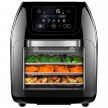
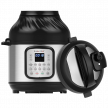

When looking at this category, it helps to separate compact air fryers from portable air fryers. Compact models are simply scaled-down versions of standard air fryers, made to save counter space but still intended to stay in the kitchen. Portable air fryers, by contrast, are either built with their own off-grid power source (like the Blackstone battery-powered unit) or designed around a container that doubles as a cooking vessel and travel-friendly storage (such as the Ninja Crispi).
But portability always comes with trade-offs in capacity, temperature control, and overall power. Understanding those compromises is key to choosing the right one. If you’re unsure about what you need, check out my main buyer’s guide for air fryers.
Quick Answer: Who Should Buy What?
- Camping or tailgating off-grid? Get a battery-powered portable air fryer (propane + battery). True independence from outlets is the priority.
- Meal prepping and taking food on the go? Choose a glass-container portable model (like lid + bowl designs). Cook and store in the same container.
- Cooking for one or two people only? Either style works — capacity typically maxes out around 3–4 quarts.
- Want precise temperature control? Skip most glass preset-only models and look for adjustable-temp portable units.
- Cooking for a family or full meals regularly? A portable model likely isn’t enough — consider a 6-quart+ basket or toaster oven air fryer instead.
How To Choose a Portable Air Fryer
Form Factor
Portable air fryers fall into two main categories:
Glass-Container Style
These designs place the heating element and fan in a detachable lid that sits on top of a glass bowl.
The bowl doubles as:
- The cooking vessel
- A serving container
- A storage container (often with an airtight lid included)
This design is lightweight and space-efficient. However, the glass becomes very hot during cooking, and long-term durability depends heavily on glass quality.
Best for: indoor use, meal prep, transportable leftovers.
Battery-Powered Style
These models are built for outdoor cooking and often require both batteries and propane.
They operate more like traditional basket air fryers but are:
- Heavier
- Bulkier
- Limited in capacity
The major advantage is true off-grid functionality.
Best for: camping, tailgating, outdoor cooking without electricity.
Capacity
Capacity is the first real limitation you’ll notice.
- Glass-container models: typically up to 4 quarts
- Battery-powered models: usually 3–3.5 quarts
- Standard basket air fryers (for comparison): around 6 quarts
That means portable models are best for:
- One or two people
- Small batches
- Side dishes
If you think this won’t be enough, slightly bigger compact air fryers might be a better option.
Temperature
Temperature control is another area where portability comes with limitations.
Glass Models
- Often preset-based
- Common range: 380–450°F (194–233°C)
- Some include dehydration around 140°F (60°C)
- Little to no manual adjustment
This makes them easy to use but less versatile.
Battery-Powered Models
- Adjustable temperature dials (good for experimenting with recipe timing etc)
- Range can extend from 315–490°F (158–255°C)
However, overall cooking performance is still constrained by power limitations, so you may not get the same even heating or consistency as you would with a kitchen-bound unit.
Time
Battery-powered models are limited by available fuel and battery life. Manufacturers rarely publish exact runtime numbers, so user reviews become important here.
Glass-container models plug into the wall and are less restricted, but many cap out around 60 minutes.
Controls
As discussed in the temperature section, portable air fryers are pretty paired down. You either have basically just temperature and time controls for the battery powered one or preset modes and time settings for the portable glass ones. That means either no modes or just modes. And you’re generally getting just four or five modes.
Now, the interfaces are the typical buttons with a clear readout to tell you how much time is left, so using them is about as easy as air fryers get. But don’t expect to be able to tweak and adjust the way one can with a typical air fryer. You’ll have to decide if the portability is worth the trade-offs here (and elsewhere).
Build
Glass Models
Pros:
- No nonstick coatings
- No PFAS/Teflon concerns
- Dishwasher-safe bowls (often)
Cons:
- Glass gets very hot
- Risk of cracking from thermal shock or drops
Look for:
- High-heat rating (450°F+)
- Dishwasher and microwave safe labeling
- Sturdy handles
Battery Models
Pros:
- Rugged metal exterior
- Built for outdoor environments
Cons:
- Heavy
- Bulkier
- More complex fuel system
Durability is usually stronger externally, but upkeep may be higher over time.