






















Summary: Measuring your suitcase the right way helps you avoid airline fees and last-minute surprises. Here’s how to check your bag size, calculate linear inches, and make sure it fits your trip.
Introduction
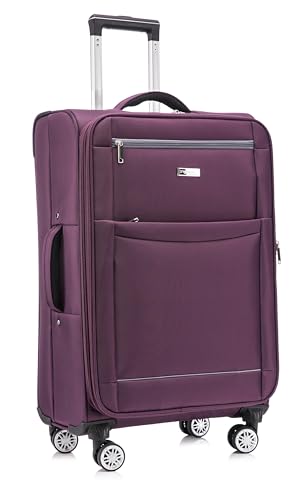
Suitcase sizes aren’t always as straightforward as they seem. The dimensions listed by brands don’t always reflect how airlines measure, and small differences can be enough to push your bag over the limit. Wheels, handles, and how full your suitcase is all play a role in the final size.
Knowing exactly how to measure your suitcase helps you avoid last-minute surprises at the airport. With a few quick checks, you can confirm whether your bag fits carry-on limits, stays within checked luggage rules, and actually works for the way you travel. Before choosing a bag, it helps to read our guide on suitcases so you understand how sizing, materials, and features affect real-world travel.
What You’ll Need
You don’t need anything complicated, but using the right tools makes your measurements more accurate and repeatable:
- A tape measure or yardstick. A retractable tape measure is easiest to use, especially when measuring height on your own. A flexible sewing tape works, but it’s harder to keep straight.
- A flat wall or door. Placing your suitcase against a wall helps you measure vertically without guessing angles. It keeps your tape aligned and reduces small errors that can push you over airline limits.
- A luggage scale (optional, but worth it). Most checked bags are limited to 23 kg / 50 lb, while carry-on limits vary by airline (some are as low as 7–10 kg). A small handheld scale can help you avoid overweight fees, which often cost far more than the scale itself.
- Your phone (optional, but useful). Taking a quick photo of your measurements gives you a reference if you need it later. It can also help if you’re double-checking dimensions before a trip.
How To Measure a Suitcase (Step-By-Step)
-
Set Your Bag Upright on a Hard Surface
![[MK]: How to Measure a Suitcase](https://www.market.com/wp-content/uploads/2026/04/-mk-how-to-measure-a-suitcase-1.png)
Place your suitcase on a solid floor like tile, wood, or concrete. Avoid carpet, since the wheels can sink slightly and throw off your height measurement.
If possible, measure the suitcase when it’s packed or partially filled. A fully packed bag expands and bulges, especially soft-shell models or expandable suitcases, which can increase overall size.
2. Measure the Height (Including Wheels)
![[MK]: How to Measure a Suitcase](https://www.market.com/wp-content/uploads/2026/04/-mk-how-to-measure-a-suitcase-2.png)
Measure from the floor to the highest point of the suitcase.
- Include wheels (especially spinner wheels, which can add 5–7 cm / 2–3 inches)
- Keep the telescopic handle fully collapsed
- Measure straight up, using the wall as a guide if needed
3. Measure the Width at the Widest Point
![[MK]: How to Measure a Suitcase](https://www.market.com/wp-content/uploads/2026/04/-mk-how-to-measure-a-suitcase-3.png)
Measure horizontally across the suitcase from side to side.
- Focus on the widest part, usually around the middle
- Include external pockets or compartments, especially if they expand when packed
Soft-shell suitcases and front-opening carry-ons can widen noticeably once filled.
4. Measure the Depth (Front to Back)
![[MK]: How to Measure a Suitcase](https://www.market.com/wp-content/uploads/2026/04/-mk-how-to-measure-a-suitcase-4.png)
Measure from the front of the suitcase to the back, at the point that sticks out the most.
- If your suitcase has an expansion zipper, unzip it before measuring if you plan to use that extra space
- Pay attention to bulging areas, often near the bottom when packed
5. Calculate Total Linear Dimensions
![[MK]: How to Measure a Suitcase](https://www.market.com/wp-content/uploads/2026/04/-mk-how-to-measure-a-suitcase-5.png)
Add your three measurements together:
Total Size = Height + Width + Depth
Airlines often use this total linear size to determine whether your suitcase qualifies as checked luggage or meets size restrictions.
- Carry-on limits are usually set by individual dimensions (e.g., 55 × 40 × 20 cm)
- Checked luggage is often limited by total linear size (commonly around 158 cm / 62 inches)
What To Avoid
- Measuring an empty suitcase – it will almost always be smaller than when packed
- Ignoring wheels and handles – airlines never do
- Forgetting expansion zippers – these can push you over the limit without realizing it
- Rounding down measurements – even small differences can matter at the gate
What Are Linear Inches – and Why Do Airlines Care?
Linear inches are simply the total size of your suitcase, calculated by adding its height, width, and depth. Airlines use this single number to simplify things. Instead of evaluating three separate measurements, they can quickly determine whether your bag fits within their limits.
Linear Inches = Height + Width + Depth
In practice, this means very different-shaped bags can be treated the same. A tall, narrow suitcase and a short, wide one can both fall within the same linear-inch limit, even though they look completely different.
For example, a carry-on that measures 22 inches tall, 14 inches wide, and 9 inches deep adds up to 45 linear inches. That’s right at the limit for many airlines, so there’s very little margin for error once the bag is packed.
Most airlines cap checked luggage at 62 linear inches. Once you go over that, you’re typically into oversized territory, where fees can easily reach $100–$200 each way. Some airlines allow larger bags, but they almost always charge extra.
What Size Suitcase Do You Actually Need?
Most suitcases fall into four main categories, and the right one depends less on the bag itself and more on how you travel.
In general, carry-ons are designed for short trips where you want to move quickly and avoid baggage claim. Medium suitcases are the most versatile option for longer travel, while large suitcases are best reserved for extended trips or when you’re packing for more than one person.
One thing worth noting: suitcase manufacturers now design very close to airline limits. That helps maximize packing space, but it also means there’s less room for error. A slightly overpacked bag or expanded zipper can push you over the limit.
How Do You Choose the Right Suitcase for Your Trip?
Start with your trip, not the suitcase. The length of your stay, the climate, and how much flexibility you want at the airport all matter more than the exact dimensions.
If you’re traveling for a few days, especially for business or a warm-weather trip, a carry-on is usually enough. It lets you skip baggage claim, reduces the risk of lost luggage, and makes tight connections easier to manage. It also works well if you have access to laundry or tend to pack efficiently.
That said, carry-ons aren’t always as straightforward as they seem. Smaller planes, especially regional jets, often have limited overhead space. Even if your bag technically meets size requirements, you may still be asked to gate-check it.
When Should You Check a Bag Instead?
Once your trip stretches beyond a week, or you’re dealing with bulky items like coats or boots, checked luggage becomes the more practical option. Cold-weather packing alone can take up far more space than most carry-ons allow.
Checked bags also make sense when you’re traveling with family, bringing gifts, or carrying full-size toiletries and liquids that exceed airport security limits. In these situations, trying to force everything into a carry-on usually creates more stress than it saves.
There’s also a trade-off to consider. You’ll spend more time at the airport waiting at baggage claim, but you’ll have far more flexibility in what you can bring.
The Two-Bag Strategy (Best of Both Worlds)
For longer trips, combining a carry-on with a checked bag is often the most reliable approach. The carry-on holds anything essential or difficult to replace, such as a change of clothes, toiletries, medications, and electronics. The checked bag takes care of bulkier items and anything you wouldn’t need immediately if it were delayed.
This setup gives you a buffer. Even if your checked luggage arrives late, you’re not stuck without the basics.
What Counts as a Personal Item?
A personal item is the smaller bag that fits under the seat in front of you. While airlines allow it in addition to a carry-on, the size limits are stricter than many people expect.
Most airlines allow something roughly the size of a small backpack or laptop bag, but depth is often the limiting factor. Bags that are too thick can struggle to fit under the seat, especially in economy, where space is tight.
Budget airlines tend to enforce these limits more aggressively. An overstuffed backpack that looks fine in the terminal can easily get flagged at the gate.
Key Takeaways
Measuring your suitcase takes less time than waiting for your coffee to brew, and it gives you clarity before you ever get to the airport.
Always measure your bag fully packed, with wheels included and handles collapsed. Add the dimensions to get your linear inches, and you’ll know exactly where your suitcase stands against airline limits.
Airlines are enforcing size rules more consistently than they used to. A bag that passed a year ago might not pass today, especially on stricter or smaller aircraft. Two minutes of measuring at home is a lot easier than repacking your suitcase at the gate or paying unexpected fees.