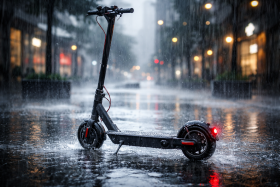














Summary: Generally, electric scooters are not waterproof. They’re usually water-resistant, which means they can handle light rain and splashes but aren’t designed for heavy rain, deep puddles, or submersion.
Most electric scooters can handle a little rain – but far less water than most riders assume. Many models advertise water resistance with ratings like IPX4 or IPX5, yet that doesn’t mean they’re safe in heavy rain, deep puddles, or flooded streets.
Understanding what your scooter can actually handle can save you from costly water damage and voided warranties. I’ll break down what “waterproof” really means for electric scooters, how IP ratings translate to real riding conditions, and how to tell whether your scooter can safely handle wet weather.
If you’re new to electric scooters and want a broader overview of features, performance, and types of models available, you can see our main guide to electric scooters.
What Does “Waterproof” vs. “Water-Resistant” Actually Mean for Electric Scooters?
“Waterproof” implies complete protection from water, including full submersion. In theory, a waterproof device could sit underwater without allowing moisture inside. In practice, almost no consumer electric scooter is built this way. Scooters contain multiple electronic components, exposed charging ports, seams in the deck, and wiring connections that make perfect sealing extremely difficult.
Most scooters instead offer water resistance. “Water resistance” means the scooter can tolerate limited exposure to moisture, such as light rain or splashes from puddles. However, that protection only goes so far. Extended exposure to heavy rain, deep puddles, or flooding can still allow water to enter sensitive components.
A useful comparison is a water-resistant watch. It can handle splashes or handwashing, but it isn’t designed for deep diving.
What Do IP Ratings on Electric Scooters Actually Mean?
“IP” stands for Ingress Protection, a standardized rating system that measures how well a device prevents dust, debris, and water from entering its internal components. An IP rating usually appears as two numbers, such as IP54 or IP65.
Each number represents a different type of protection:
First Number: Dust Protection
The first digit (0–6) indicates how well the device blocks solid particles such as dust or sand.
- 5 means dust can enter in very small amounts, but won’t damage internal parts
- 6 means the device is completely dust-tight
If you see X instead of a number (for example, IPX5), it means that category was not tested, not necessarily that the device lacks protection.
Second Number: Water Protection
The second number indicates how well the device resists water exposure. Higher numbers generally mean the scooter can withstand stronger or longer water contact, such as heavier rain or spray. However, even high ratings do not mean the scooter is safe to submerge, which is a common misunderstanding.
What Each IP Rating Means for Real-World Riding
Understanding the water rating helps you determine what conditions your scooter can realistically handle.
IPX4 (Most Common)
An IPX4 rating means the scooter can handle water splashing from any direction for a limited period, typically around 10 minutes under standardized testing. In practical terms, this means:
- Getting caught in light rain on your way home is usually fine
- Small puddle splashes won’t cause problems
- Occasional moisture exposure is generally safe
At first, this sounds reassuring. But there’s an important limitation: most rides last longer than 10 minutes, and rain rarely stops exactly when you need it to. Extended water exposure increases the chance that moisture slowly finds its way into seams, ports, or internal components.
IPX5
With an IPX5 rating, the scooter can withstand low-pressure water jets, which translates to better protection against rain and road spray. In real-world conditions, scooters rated IPX5 can typically handle:
- Steady rainfall
- Water spray from passing vehicles
- Riding on consistently wet roads
This level of protection also means the scooter can usually tolerate light rinsing with a hose (using a gentle shower setting rather than high pressure). For riders who commute regularly, IPX5 is often considered the minimum rating for reliable wet-weather riding.
IP65 and IP66
At IP65 and IP66, protection becomes significantly stronger. These ratings mean the scooter can handle sustained water jets under pressure, which offers much better resistance to harsh conditions. Scooters with these ratings generally tolerate:
- Heavy rain
- Strong road spray
- Wet conditions that many riders would normally avoid
This is the point where some manufacturers start using “waterproof” language in marketing, although technically these scooters are still classified as water-resistant devices.
IPX7
An IPX7 rating indicates temporary immersion protection. Under testing conditions, the device can survive being submerged in up to 1 meter (about 3 feet) of water for up to 30 minutes. This rating occasionally appears on premium scooter components, but rarely applies to the entire scooter.
For example, some production scooters advertise IP67-rated batteries, meaning the battery is both dust-tight and protected against temporary immersion. That level of protection is among the highest commonly found on individual scooter components. However, even with IPX7 protection, scooters are not designed to operate underwater, and other parts of the vehicle may still be vulnerable.
IPX8
IPX8 extends immersion protection beyond 1 meter and for longer durations, though the exact depth and time limits are defined by the manufacturer. Scooters and bikes don’t need this rating because these vehicles aren’t designed to go underwater, so this rating typically applies to diving equipment and marine electronics.
One notable exception comes from the shared-scooter industry. Rental company Bird reportedly vacuum-sealed battery units to achieve an IP68 rating, helping their scooters survive years of outdoor exposure in the rain. Even in these cases, the rating typically applies to specific components, not the entire scooter.
IP9K
IP9K represents the highest level of water protection in the IP rating system. Devices with this rating can withstand extremely powerful, high-temperature water jets (up to 80°C).
This level of protection is typically used for industrial equipment that must be cleaned with pressure washers, such as machinery in food-processing or manufacturing environments. For personal electric vehicles, IP9K is far beyond what’s necessary or practical.
What Manufacturers Get Wrong About Waterproofing
One IP rating for your entire scooter doesn’t tell the full story. Your scooter has multiple components, each with different vulnerabilities: the display and throttle up front, the battery in the deck, the motors, the charging port, and the controller coordinating everything. Each of these might have seals or gaskets, but offers different degrees of protection, creating multiple entry points for water.
Manufacturers that provide detailed specifications often list separate IP ratings for individual components. For example:
- Motor rated IP55
- Battery rated IP67
- Display rated IP65
This approach gives a much clearer picture of where the scooter is most vulnerable.
Why These Components Matter
Not every part of a scooter needs the same level of sealing. Some components are far more sensitive to water than others, which is why manufacturers often give them different levels of protection.
- Battery: Water intrusion can create short circuits or fire risks, so it usually receives the highest protection
- Controller: This unit manages the scooter’s electrical systems, so water damage can disable the scooter entirely
- Motor: Water can corrode internal windings and bearings, though hub motors are often partially sealed
- Display and throttle: Moisture easily damages screens and internal circuitry
These are also the most expensive components to replace, which makes water damage particularly costly.
Are Any Electric Scooters Truly “Waterproof”?
By now, the answer is clear: fully waterproof electric scooters are extremely rare.
You won’t find a scooter that you can confidently sink in a lake and ride out without issues – at least not a commercial one meant for the average consumer. There are some very water-resistant electric scooters out there, though. For example, some high-end urban or rugged off-road electric scooters advertise ratings like IP65 or IP66, which provide strong protection against rain and spray. For everyday riders, this level of resistance is usually sufficient for commuting in wet conditions.
Even with these high ratings, manufacturers still caution against deliberately submerging or excessively wet use. Water will find a way in if you give it enough time or find a weak spot, which is made worse by the fact that scooters keep everything close to the ground. Your battery, controller, and motor all sit inches from road spray. Compare this to an e-bike, where components mount higher on the frame. Scooters face more water exposure by design.
And once again, most warranties exclude water damage, even when scooters are marketed as weather-resistant.