




























Most speakers may look similar on the outside, but what’s inside—specifically the drivers—has a huge impact on how they sound.
That’s where 2-way and 3-way designs come in. On paper, the difference is simple: one has two drivers, the other has three. But in practice, that extra driver changes how sound is handled across frequencies, affecting clarity, balance, and the overall listening experience.
This guide breaks down what “2-way” and “3-way” actually mean, how they sound in real-world use, and when the upgrade to 3-way is actually worth it.
You can learn about other speaker specs and features in our main guide.
Quick Answer: 2-Way vs 3-Way Speakers
2-way speakers use a woofer and tweeter and are great for most setups. 3-way speakers add a dedicated midrange driver, which improves clarity (especially for vocals and complex audio), but the difference is most noticeable at higher volumes or in larger rooms.
What Does “2-Way” and “3-Way” Mean?
Understanding Speaker Drivers (Quick Breakdown)
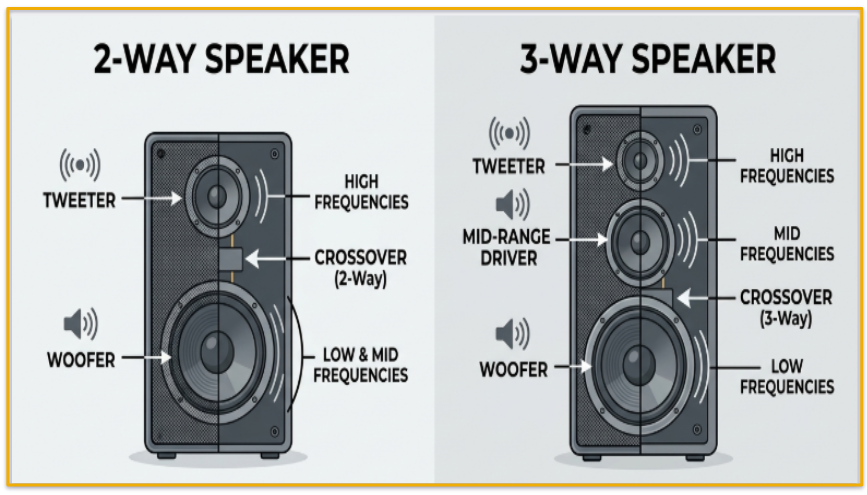
Drivers are the components that actually produce sound:
- Woofer: Handles bass (low frequencies)
- Midrange: Handles vocals and instruments
- Tweeter: Handles high frequencies (detail and clarity)
In 2-way speakers, the woofer does double duty (bass + mids). In 3-way speakers, each range has its own dedicated driver:
- 2-way speakers:
- 1 woofer (lows + mids)
- 1 tweeter (highs)
- 3-way speakers:
- 1 woofer (lows)
- 1 midrange driver (mids)
- 1 tweeter (highs)
Main Differences Between 2-Way and 3-Way Speakers
Real-World Use Cases
Best for 2-Way Speakers
- Desk setups / nearfield listening
- Bedrooms or small living rooms
- Casual music, TV, or gaming
Best for 3-Way Speakers
- Home theater setups
- Large rooms or open layouts
- Music-focused listening at higher volumes
Sound Quality Differences
Why 3-Way Sounds Better (Sometimes)
3-way speakers can sound clearer because:
- Each driver handles a smaller, specific range
- Vocals and instruments don’t compete with bass
- Sound stays balanced at higher volumes
Where the Difference Is Noticeable
You’re most likely to notice improvements with 3-way speakers when:
- Listening at higher volumes
- Using them in larger rooms
- Playing complex audio (jazz, orchestral, detailed mixes)
Where It Doesn’t Matter Much
In many everyday setups:
- Small rooms
- Background music
- Casual listening
In these situations, a 2-way speaker often sounds just as good.
Pros and Cons
2-Way Speakers
Pros
- More affordable
- Compact and easy to place
- Simple to set up
Cons
- Less detailed mids
- Can sound less clear at high volumes
3-Way Speakers
Pros
- Better clarity and separation
- Stronger performance at volume
- More balanced sound overall
Cons
- Larger and less flexible placement
- Can require more power to perform well
- Not always noticeably better in small setups
Do You Actually Need 3-Way Speakers?
Not always.
- Many people won’t notice a big difference in everyday use
- Room size, speaker quality, and setup matter just as much
When 2-Way Speakers Make More Sense
Choose 2-way speakers if you want:
- A simpler setup
- A more compact speaker
- Great sound without overthinking it
- A better fit for desks, bedrooms, or small spaces
For most people, this is enough.
When 3-Way Speakers Are Worth It
Upgrade to 3-way speakers if you:
- Want clearer vocals and separation
- Listen at higher volumes regularly
- Have a large or open room
- Care about audio detail and soundstage
This is where the extra driver actually pays off.

